
As first reported by IPRlearn, the Research Office of Shihezi University in Xinjiang, China, posted a June 18, 2026 Notice on Prudently Regulating Overseas Patent Filings and Ceasing Patent Applications in Countries Without Substantive Examination Systems (关于审慎规范海外专利布局、停止在无实质审查制度国家申请专利的通知). In the Notice, the University stated “the China National Intellectual Property Administration (CNIPA) is conducting a special inspection and rectification campaign targeting overseas patent applications in countries without a substantive patent examination system. Organizations that illegally and excessively deploy such low-stability patents will be publicly notified, and their applications will be deemed abnormal, impacting university intellectual property assessments, research project applications, and other related work.” A corresponding notice confirming this campaign was not available on CNIPA’s website.
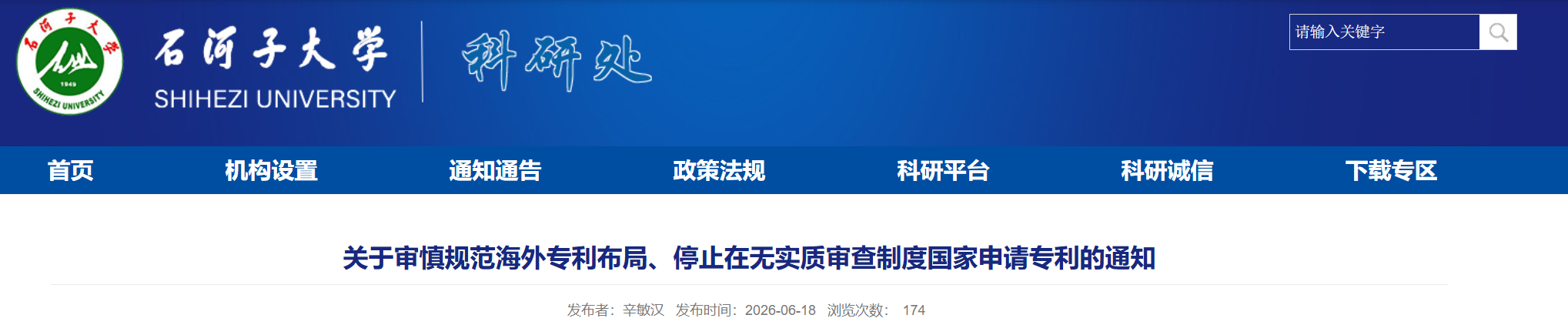 The original text can be found here (Chinese only). A translation of the Notice follows:
To all colleges, research units, faculty, staff, and researchers:
To thoroughly implement the national intellectual property strategy, standardize our university’s overseas patent layout, and prevent the outflow of abnormal patent applications from causing adverse international impacts, in accordance with the relevant inspection and rectification requirements of the China National Intellectual Property Administration and in light of the current status of our university’s overseas patent applications, the following requirements regarding overseas patent filings are hereby notified:
- Current Situation Description
In recent years, the university has continuously strengthened its efforts in promoting intellectual property rights and protecting research results, and encouraged researchers to apply for patents both domestically and internationally. As a result, the number of international patent applications and authorizations across the university has steadily increased.
Countries such as South Africa, Luxembourg, the Netherlands, Belgium, and Cambodia have not established a substantive patent examination system, resulting in weak legal stability for related patents and making it difficult to effectively protect innovative achievements. Patents in these countries are characterized by low authorization thresholds, short processing times, and low application costs. Precisely because of these characteristics , some teachers unilaterally pursue short processing times, neglecting the core requirements of patent quality and legal validity. This leads to some low-value patents flowing to regions with weak supervision, which not only fails to form effective technological barriers but may also damage the school’s academic reputation and international image.
- Work Requirements
(i) No new filings are allowed
All researchers, faculty, and students are strictly prohibited from filing new patent applications or submitting new patent application materials in countries without a substantive patent examination system, such as South Africa, Luxembourg, the Netherlands, Belgium, and Cambodia.
(ii) Voluntarily withdrawing a pending application
For the aforementioned national patent applications that have already been submitted and are still under examination, each college must organize the relevant inventors to complete the voluntary withdrawal procedures as soon as possible to prevent the risk of abnormal patent spillover.
(iii) Prioritize countries with compliant systems
For overseas intellectual property protection, it is recommended to prioritize countries with sound substantive patent examination systems and stable patent rights, such as the United States, Canada, Japan, and Australia, to effectively leverage the core role of patents in protecting innovative achievements.
(iv) Strengthen the management responsibility of the college
All colleges must attach great importance to this patent rectification work, conduct a comprehensive review of their patent records in countries without substantive examination, and carry out policy dissemination and rectification supervision.
III. Work Supervision
The China National Intellectual Property Administration is conducting a special inspection and rectification campaign targeting overseas patent applications from countries without a substantive patent examination system. Organizations that illegally and excessively deploy such low-stability patents will be publicly notified, and their applications will be deemed abnormal, impacting university intellectual property assessments, research project applications, and other related work. All organizations and researchers are requested to strictly comply with the requirements of this notice and regulate their overseas patent deployment practices.
Research Office of Shihezi University
June 18 , 2026
