
On December 20, 2025, China’s Supreme People’s Court (SPC) released the Draft Interpretation (III) on Several Issues Concerning the Application of Law in the Trial of Patent Infringement Disputes (最高人民法院关于审理侵犯专利权纠纷案件应用法律若干问题的解释(三)) for comment. The Interpretation contains 31 articles covering issues such as jurisdiction, standing to sue, interpretation of claims, infringement comparison, defense of non-infringement, change of circumstances, malicious litigation, and compensation. Some highlights include:
- Article 3 – no forum shopping by shipping to a favorable jurisdiction.
- Article 4 – litigation can be suspended based on an invalidation filed with CNIPA if an initial patent evaluation report was negative.
- Article 8 – exclusive licensees can sue for patent infringement, non-exclusive licensees can also sue with the patent owner’s permission. No double dipping – patentee can’t sue again on some infringement after the exclusive licensee sued.
- Article 19 – can’t combine two technical solutions from a single document for prior art defense. However, content recorded in same document can be combined for a prior art defense when mutually interpretable in meaning, mutually supportive in technology, and jointly solves a technical problem.
- Article 25 – defines malicious patent litigation including specifically when a company registers for IPO.
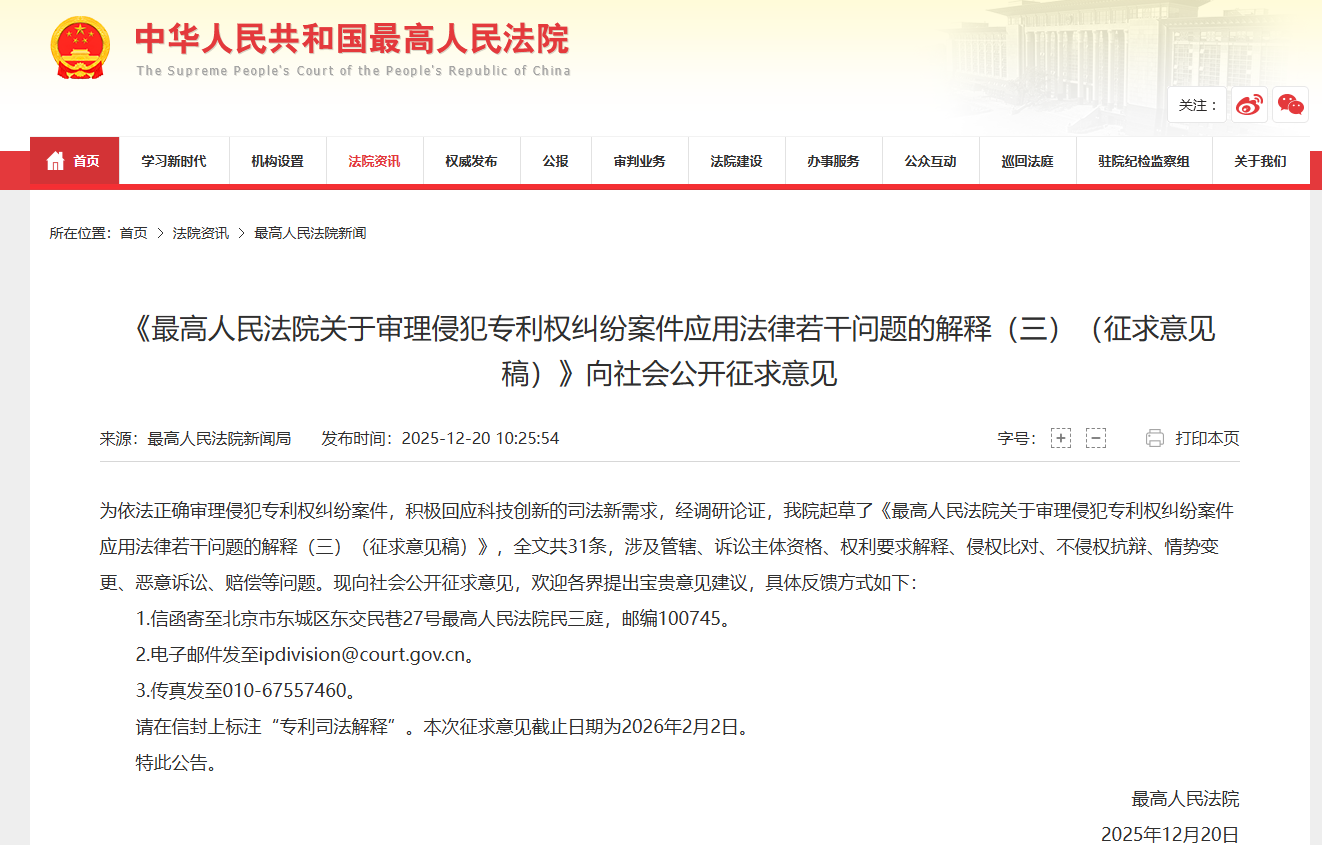 A translation follows. The original is available here (Chinese only). Comments are due February 2, 2026.
To ensure the proper adjudication of patent infringement disputes in accordance with the law, this interpretation is formulated based on the relevant provisions of the Civil Code of the People’s Republic of China, the Patent Law of the People’s Republic of China, the Civil Procedure Law of the People’s Republic of China, and other relevant laws, and in light of judicial practice .
Article 1: Where a defendant raises an objection to jurisdiction on the grounds that the plaintiff has created a connection by falsely listing defendants, the People’s Court shall examine whether there is an actual connection between the defendant on whom the connection to jurisdiction is based and the disputed matter. Where
a defendant raises an objection to jurisdiction solely on substantive grounds such as non-infringement or breach of contract, or that they should not bear liability, the People’s Court generally will not examine it, except where the alleged infringing act clearly does not constitute an infringing act as defined by law.
Article 2: Where a party appeals a first-instance ruling rejecting an objection to jurisdiction, the first-instance People’s Court may organize an exchange of evidence and convene a pre-trial conference before the second-instance People’s Court makes a final ruling, but may not render a judgment. If the second-instance People’s Court rules that the objection to jurisdiction is valid, the transcripts of the aforementioned evidence exchange and pre-trial conference shall serve as the basis for the trial by the People’s Court to which the case is transferred.
Article 3 The place of sale used by the People’s Court to determine jurisdiction in patent infringement disputes generally includes the seller’s principal place of business, the place where the allegedly infringing product is stored, or the place of seizure or detention, but does not include the place of delivery that the plaintiff can arbitrarily choose, or the place of receipt for online shopping.
Article 4 In cases of infringement of utility model or design patent rights, the People’s Court may, in accordance with Article 66, Paragraph 2 of the Patent Law, require the plaintiff to submit a patent evaluation report. If the plaintiff refuses to submit it without justifiable reason within a reasonable period, the People’s Court shall rule to dismiss the lawsuit.
If the patent evaluation report submitted by the plaintiff concludes that the statutory conditions for granting a patent right are not met, the People’s Court shall explain to the defendant whether they assert prior art or prior design defenses and whether they request the patent administration department under the State Council to declare the patent right invalid. If the defendant requests suspension of the litigation on the grounds of requesting the patent administration department under the State Council to declare the patent right invalid, the People’s Court shall rule to suspend the litigation, unless the infringement is not established.
Article 5 Before the conclusion of the court debate in the second instance proceedings, if the claims asserted by the right holder are declared invalid by the patent administration department under the State Council and their legal effect is determined to be effective, and the right holder requests a change to the asserted claims, the People’s Court shall grant the request; if, after explanation, the right holder still asserts the invalidated claims, the People’s Court shall not support it.
Before the conclusion of the court debate in the second instance proceedings, if the amendments to the claims asserted by the right holder are accepted by the patent administration department under the State Council and their legal effect is determined to be effective, the People’s Court shall compare the amended claims with the accused infringing technical solution.
Article 6 If the claims asserted by the right holder are declared wholly or partially invalid, or if the amendments are accepted by the patent administration department under the State Council, the right holder shall promptly inform the People’s Court hearing the patent infringement lawsuit. If the right holder fails to inform the court in a timely manner without justifiable reason, the People’s Court may order the right holder to bear the corresponding adverse consequences.
Article 7 The People’s Court may require the parties to submit information on cases related to the patent in question. If the parties refuse to submit such information within a reasonable period without justifiable reason, the People’s Court may order the right holder to bear the corresponding adverse consequences.
Article 8 The interested parties stipulated in Article 65 of the Patent Law include licensees of patent licensing contracts, legal successors of patent rights, etc.
A licensee under an exclusive license agreement may file a lawsuit independently in a People’s Court. A licensee under a sole license agreement may file a lawsuit jointly with the patentee, or may file a lawsuit independently if the patentee does not file a lawsuit. A licensee under an ordinary license agreement may file a lawsuit independently with the express authorization of the patentee.
If the claim for damages by the licensee under an exclusive license agreement is supported, the People’s Court shall not support the patentee’s claim for damages for the same act in other lawsuits, unless the patentee can prove that the infringement caused other damages to it.
Article 9 If a transferee, authorized by the transferor, files a lawsuit in its own name against an infringement that occurred before the patent transfer registration date, the People’s Court shall review it.
Article 10 If the accused infringing technical solution has a prior art defect that the patent is intended to overcome as described in the specification, the People’s Court shall determine that it does not fall within the scope of patent protection.
Article 11 If the accused infringer can prove that the restrictive modifications or statements made by the patent applicant or patentee to the claims, specification, and drawings during the patent grant and confirmation procedure were not explicitly denied, and the patentee claims in a patent infringement dispute that the aforementioned restricted portion should be included within the scope of patent protection, the People’s Court shall not support such a claim.
Article 12 If a person skilled in the art, by reading the claims, specification, etc., can determine that the claims intentionally exclude a specific technical solution, and the patentee claims that such a specific technical solution falls within the scope of patent protection, the People’s Court shall not support such a claim.
Article 13 If a technical feature in a patent claim limits a function or effect, and limits or implies a specific structure, component, step, condition, or their interrelationship corresponding to that function or effect, the People’s Court shall determine that the technical feature does not constitute a functional feature.
Article 14 If the accused infringer, for production and business purposes, solidifies the substantive content of the patented method in the accused infringing product, and this plays an irreplaceable role in reproducing the patented technical solution, the People’s Court may determine that the accused infringer has implemented the patented method.
Article 15 If a person skilled in the art, after reading the claims, specification, patent examination files, reference books, textbooks, etc., still cannot determine the specific meaning of the technical terms in the claims, making it impossible to compare them with the allegedly infringing technical solution, the People’s Court shall rule to dismiss the claimant’s lawsuit based on those claims.
Article 16 If a party applies for inspection of the allegedly infringing product, the People’s Court may require the parties to first negotiate and determine the inspection plan; if the negotiation fails, the People’s Court shall determine it. If there are objective obstacles to inspecting the physical object of the allegedly infringing product, making it impossible to use the physical product as a basis for technical comparison, and the right holder claims to determine the allegedly infringing technical solution based on the technical drawings, specifications, and other technical data used to manufacture the physical object of the allegedly infringing product, the People’s Court may determine it based on such technical data and in conjunction with common general knowledge, unless the alleged infringer submits sufficient contrary evidence to refute it.
Article 17 The People’s Court may determine the scope of protection of a design patent in conjunction with the brief description of the design. If the pictures or photographs of a design patent for a product in a changed state are clearly inconsistent with the brief description, a reference drawing of the usage state should be considered.
Article 18 If the accused infringing product only displays a partial view, but a general consumer can infer the design features of the remaining views based on that partial view and the characteristics of the product type, the People’s Court may use this as the basis for infringement comparison, unless the accused infringer submits sufficient contrary evidence to refute it.
Article 19 If the defendant asserts a prior art defense based on a combination of two or more different technical solutions recorded in the same prior art document, the People’s Court shall not support it.
If the defendant asserts a prior art defense based on content recorded in different parts of the same prior art document, and the aforementioned content is mutually interpretable in meaning, mutually supportive in technology, and jointly solves a technical problem, the People’s Court shall support it.
If a defendant asserts a prior art defense based on a combination of prior art described in a comparative document and common general knowledge, and such prior art is something that a person skilled in the art could conceive of without inventive effort, the People’s Court should generally support it.
Article 20: If a party did not assert a prior art or prior design defense in the first instance proceedings but raises it in the second instance proceedings, the People’s Court should review it. If a party did not assert a prior art or prior design defense in either the first or second instance proceedings but raises it in the trial supervision proceedings, the People’s Court will not review it.
If a party’s prior art or prior design defense is not supported, and the party submits new evidence in subsequent proceedings to strengthen the proof of the same prior art or prior design, the People’s Court should review such evidence.
Article 21: If a party asserts a non-infringement defense based on a prior application filed with the State Council’s patent administration department, and all technical features of the accused infringing technical solution have been separately and completely disclosed in the prior application, the People’s Court should determine that there is no patent infringement.
Article 22 If the accused infringing product lacks the manufacturer’s name, address, product quality inspection certificate, or other markings, and the accused infringer claims it is a “patent infringing product manufactured and sold without the patentee’s permission” as stipulated in Article 77 of the Patent Law, the People’s Court shall not support this claim, unless the accused infringer submits sufficient contrary evidence to refute it.
Article 23 If the accused infringing product or promotional materials bear the accused infringer’s trademark, trade name, “factory direct sales,” “brand self-operated,” or other markings and do not indicate other operators, or indicate the accused infringer as the manufacturer or producer, and the rights holder claims the accused infringer engaged in manufacturing, the People’s Court shall support this claim, unless there is contrary evidence proving that another person was the manufacturer.
Article 24 If the defense of legitimate source is established, and the rights holder requests a judgment ordering the accused infringer to bear the reasonable expenses incurred in stopping the infringement, the People’s Court shall not support this claim.
(Option 2: If the defense of legitimate source is established, and the right holder requests the court to order the accused infringer to bear the reasonable expenses paid to stop the infringement, the people’s court may provide appropriate support based on its sales situation, unless the manufacturer of the infringing product has already borne reasonable expenses.)
Article 25 If a person knowingly lacks legal or factual basis and initiates a patent infringement lawsuit for the purpose of obtaining illegitimate benefits, causing damage to others, he or she shall bear liability for damages.
The people’s court may consider the following factors when determining that a patent infringement lawsuit is maliciously initiated:
(1) knowingly obtaining the patent right based on prior art or prior design, or obtaining the patent right through deception or concealment of important facts;
(2) knowingly obtaining the patent right as invalid, confirmed by an effective judgment as belonging to another person, or as having expired;
(3) clearly lacking legal or factual basis, and intentionally delaying or affecting the above procedures by initiating a patent infringement lawsuit at important times such as equity financing, initial public offering, additional share issuance, commercial mergers and acquisitions, or participation in bidding;
(4) other circumstances that can be identified as malicious litigation.
Article 26 When hearing cases involving disputes over liability for damages arising from malicious intellectual property litigation, the people’s court may determine the amount of compensation in accordance with the law, based on factors such as the degree of malice of the actor, the consequences of the damage, and the causal relationship.
Article 27 The “decision to invalidate a patent right” stipulated in Article 47 of the Patent Law includes decisions to invalidate all claims of a patent right and decisions to invalidate only some claims of a patent right. The “executed” stipulated in Article 47 of the Patent Law includes full execution and partial execution.
If a patent infringement judgment or mediation agreement has been partially executed, the decision to invalidate the patent right does not have retroactive effect on that part, but it has retroactive effect on the unexecuted part.
Article 28 If a patent infringement judgment finds that the infringed claims have been declared entirely invalid by the patent administration department of the State Council, and this invalidation occurred after the judgment but before the application for enforcement, the people’s court shall rule not to accept the application for enforcement or retrial; if it occurred during enforcement proceedings, the people’s court shall rule to suspend enforcement. If the aforementioned invalidation decision has become legally effective, the people’s court shall rule to terminate the enforcement proceedings.
Article 29 The People’s Court may, based on the specific circumstances of the case and comprehensively considering factors such as the nature and circumstances of the infringement and the potential impact of violating non-monetary obligations such as cessation of infringement, order a late payment penalty for non-monetary obligations. The calculation standard for such late payment penalty may be calculated on a daily, monthly, or monthly basis, or on a per-product basis, or it may be calculated as a lump sum.
Article 30 If the right holder claims that the amount of compensation should be determined based on the actual losses suffered due to the infringement, the profits obtained by the infringer from the infringement, and a reasonable multiple of the patent licensing fee, and submits corresponding evidence that allows for a reasonable estimation, the People’s Court shall support this claim, unless the defendant submits sufficient contrary evidence to refute it.
Article 31 This interpretation shall come into effect on [date]. In the event of any inconsistency between this interpretation and previous judicial interpretations issued by the Supreme People’s Court, this interpretation shall prevail.
