
On June 9, 2026, China’s Supreme People’s Court (SPC) released the Typical Cases of Technical Fact-Finding in Plant Variety Cases (植物新品种案件技术事实查明典型案例) (the “Typical Cases”) alongside the Guidelines for Ascertaining Technical Facts in Cases Involving New Plant Varieties. In the Chinese judicial system, typical cases (典型案例) are cases selected and published by the Supreme People’s Court or other courts to illustrate the application of legal standards to particular fact patterns; while they do not carry the binding precedential force of common law jurisdictions, they serve as authoritative guidance that lower courts are expected to reference and follow in deciding analogous disputes. The Typical Cases comprise three decisions selected to illustrate the application of technical fact-finding standards in plant variety rights disputes, and are expressly cross-referenced to specific provisions of the Guidelines. Together, the Guidelines and the Typical Cases are intended to provide courts at all levels with concrete operational guidance on evidentiary assessment in proceedings involving varietal identity, parentage, and related technical questions.
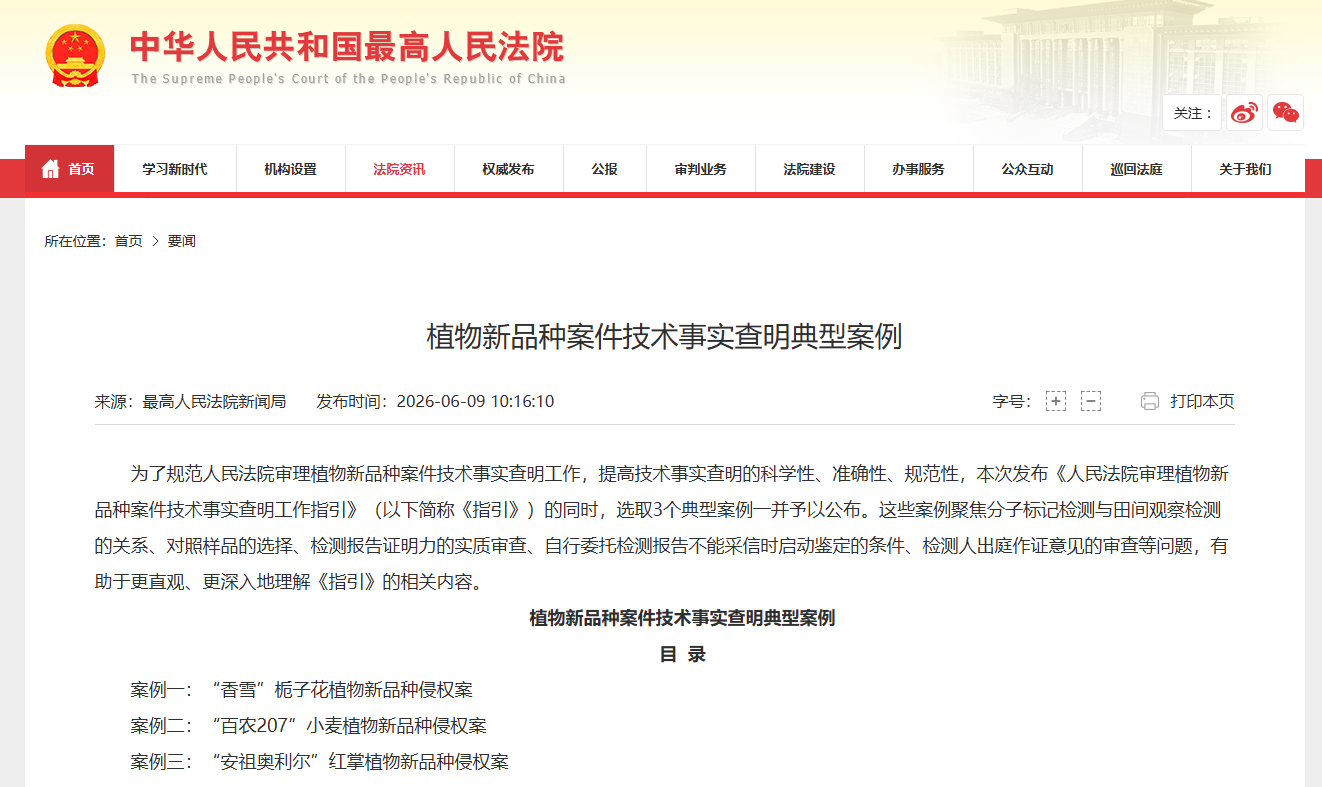
The three cases span a range of crop types and technical methodologies, and collectively address several recurring issues in plant variety litigation. The first case, concerning the “Xiangxue” gardenia variety, addresses the evidentiary weight of party-commissioned molecular marker test reports for plant species lacking dedicated national or industry standards for molecular marker detection, the hierarchy of reference sample selection, and the respective roles of molecular marker testing and field observation testing. The second case, concerning the “Bainong 207” wheat variety, addresses the treatment of party-commissioned test reports where reference sample provenance is unclear, and the circumstances under which courts should initiate court-commissioned appraisal proceedings. The third case, concerning the “Anthura Aurelie” anthurium variety, addresses the standards for assessing the scientific reliability of DNA fingerprint reports constructed from a limited sample base, and the allocation of the burden of proof where test results are inconclusive.
Across the three cases, several principles emerge that are now codified in the Guidelines. Molecular marker detection and field observation testing are treated as coordinate methods, neither taking automatic precedence over the other — though where their conclusions conflict, field observation results prevail. The scientific reliability of a test report is assessed by reference to the technical competence of the testing institution and the representativeness of the methodology employed, rather than solely by reference to formal accreditation for a particular species. Where a party-commissioned report is found to have evidentiary deficiencies, courts are directed to inform the parties and, where conditions permit, to initiate court-commissioned appraisal rather than simply dismissing the claim. These principles reflect a broader policy objective of reducing the burden on rights holders in enforcement proceedings while maintaining the integrity of the technical fact-finding process.
A translation of the Typical Cases, as explained by the SPC, follows. The original text is available here (Chinese only).
Case 1
The “Xiangxue” Gardenia plant variety infringement case [related to Articles 10, 11, 12, 19, and 24 of the Guidelines]
Second Instance: Supreme People’s Court (2025)最高法知民终202号
[Basic Case Facts]
Shengzhou XXxiang Flower and Tree Company is the variety rights holder of the new Gardenia genus plant “Xiangxue”. The company discovered through investigation that JiaXXyuan Flower Shop, ZiXX Company, and Wei XX were selling the allegedly infringing variety “Wujinxue” gardenia on multiple online e-commerce platforms without permission. In November 2023, the company, after notarization and under the witness of a notary, purchased “Wujinxue” gardenias, took samples, properly sealed them, and mailed them to the Institute of Systems Biology at Jianghan University for testing. The institute, referring to the national standard “MNP Marker Method for Plant Variety Identification,” issued an “Inspection Report,” showing a comparison of 46,131 loci, with 44 differing loci, and a genetic similarity of 99.9%, concluding that the variety was extremely similar or identical. The company believes that JiaXXyuan Flower Shop, ZiXX Company, and Wei XX jointly infringed and is suing them, demanding that they cease infringement and compensate for losses of 1 million RMB. JiaXXyuan Flower Shop, Zi XX Company, and Wei XX jointly argued that the “Inspection Report” submitted by Shengzhou XXxiang Flower and Tree Company could not be used as the basis for determining the facts because the testing unit did not have the qualification to identify Gardenia genus; the applicable testing standard for Gardenia genus is the field observation test (DUS test), and the testing method used in the report was incorrect. The court of first instance held that when both field observation test and molecular marker test standards exist, the conclusions on the determination of variety identity may differ; in the case of differences, the applicability of the two standards should be based on the conclusion of field observation test; the issuing authority of the “Inspection Report” did not have the qualification to use the MNP marker method to detect the authenticity of Gardenia variety, therefore the “Inspection Report” had deficiencies such as non-standard identification method and the testing institution lacking the corresponding qualifications, and its probative value was not confirmed. The judgment dismissed all claims of Shengzhou XXxiang Flower and Tree Company. Shengzhou XXxiang Flower and Tree Company appealed. In the second instance, the Supreme People’s Court focused on the probative value of the “Inspection Report” in question.
[Judgment Result]
The Supreme People’s Court, in its second instance ruling, held that: First, regarding the source of the control sample: The variety approval authority did not retain standard samples of the “Xiangxue” variety, but the “Expert Substantive Examination Report” in the authorization procedure clearly recorded the specific location of the mother plant, which was consistent with the location of the notarized sampling in this case. The sampling process was witnessed by a notary public throughout, and the sample was sealed by the notary office before being sent for testing. The sealing process was consistent with the record in the “Inspection Report.” Therefore, it can be determined that the control sample was propagation material of the authorized variety. Second, regarding the selection of testing methods: Specialized technical factual issues in disputes over infringement of plant variety rights can be identified using methods such as field observation and testing, and gene fingerprinting. The parties and the people’s court can choose legal, scientific, and feasible identification methods based on the specific circumstances of the case. Molecular marker detection and field observation and testing are parallel identification methods, and field observation and testing are not necessarily required or given priority. Currently, there are no specific national or industry standards for molecular marker detection in the genus *Gardenia*. However, the *MNP Marker Method for Plant Variety Identification* is a national standard, which explicitly states that “the identification of other plant varieties can refer to this standard.” Therefore, this case can refer to this standard for testing the *Gardenia* variety, which has a scientific basis. Third, regarding the scientific validity of the test data: The *Inspection Report* compared 46,131 loci, far exceeding the number of loci specified in the national standard for 16 species such as rice and corn (usually hundreds to thousands). Furthermore, the loci selection is based on the principles of MNP marker technology, covering regions of genomic polymorphism and meeting the requirements for locus polymorphism. The test results show a genetic similarity of 99.9%, which proves that the tested sample and the control sample are extremely similar or the same variety. Fourth, regarding the qualifications of the testing institution: The key consideration for the scientific validity of the test conclusion lies in whether the testing institution possesses the corresponding testing technical capabilities, rather than whether it has the qualification to identify the variety. The testing institution in question is one of the drafting units of the national standard *MNP Marker Method for Plant Variety Identification* and possesses the core testing technical capabilities of the MNP marker method. In summary, the Inspection Report is admissible as legal evidence and preliminarily proves the identity of “Wujinxue” and “Xiangxue.” After the rights holder submitted preliminary evidence, the burden of proof shifted to the accused infringing party. Because the accused party failed to fulfill its burden of proof, it should bear the adverse consequences of failing to provide evidence. Based on this, the appellate court reversed the original judgment, finding JiaXXyuan Flower Shop, Zi XX Company, and Wei XX jointly liable for infringement, and ordered them to jointly compensate Shengzhou XXxiang Flower and Tree Company over 330,000 RMB.
[Typical Significance]
This case clarifies that molecular marker detection and field observation are parallel identification methods, and field observation is not necessarily mandatory or preferred. Parties and the People’s Court can choose a legal, scientific, and reliable identification method based on the specific circumstances of the case. This case refines the rules for selecting control samples at different levels. In cases where the approving authority has not preserved standard samples, the court recognizes propagation material from mother plants examined on-site by experts during the authorized procedure as control samples, providing an operational example for determining control samples in similar cases. This case clarifies the substantive review standards for the probative value of test reports. For plant varieties for which there are no directly applicable national or industry standards for molecular marker detection, relevant national standards can be applied by analogy. This case does not dwell on the formal dispute over whether the testing institution possesses specific qualifications, but rather points out that the key consideration for the scientific validity of test conclusions lies in whether the testing institution possesses the corresponding testing technical capabilities. When reviewing test conclusions, the focus should be on examining the representativeness and quantity of the primers used, whether the establishment of the gene fingerprint conforms to scientific principles, and whether it is sufficient to scientifically and accurately distinguish different varieties, thereby determining its probative value.
Case 2
The “Bainong 207” wheat plant variety infringement case [related to Article 25 of the Guidelines]
Second Instance: Supreme People’s Court (2023)最高法知民终113号
[Basic Case Facts]
Hua XX Seed Industry Co., Ltd. is the licensee of the “Bainong 207” plant variety implementation license contract, and the variety right holder authorizes it to independently pursue legal action. Hua XX Seed Industry Co., Ltd. purchased suspected infringing seeds from Tang’s store. The packaging and QR code screenshot showed the variety name as “Sunshine 818,” and the producer/distributor as “Feng XX Seed Industry Co., Ltd.” A traceability query using the QR code showed the product was genuine, and the production unit also pointed to Feng XX Seed Industry Co., Ltd. Hua XX Seed Industry Co., Ltd. filed a lawsuit, requesting the court to order Feng XX Seed Industry Co., Ltd. and Tang’s store to cease infringement and compensate for losses of 300,000 RMB. In the first instance, Hua XX Seed Industry Co., Ltd. submitted an “Inspection Report” issued by a unilaterally commissioned testing agency, intending to prove that the allegedly infringing seeds and the authorized variety “Bainong 207” were the same variety. After review, the court of first instance determined that the control sample “Bainong 207” in the “Inspection Report” lacked a sample number, its source was questionable, and the test results were insufficient as evidence. Therefore, the court dismissed all of Hua XX Seed Industry Co., Ltd.’s claims. Hua XX Seed Industry Co., Ltd. appealed. During the second instance trial at the Supreme People’s Court, given that the allegedly infringing seeds were in good condition and met the requirements for identification, a judicial appraisal was commissioned in accordance with the law. The Beijing Wheat Seed Testing Center accepted the commission and conducted a germination test on the sample. After successful germination confirming normal seed viability, the center used the SSR molecular marker method for testing and issued an “Inspection Report” based on national standards, concluding that the two seeds were of the same variety.
[Judgment Result]
The Supreme People’s Court, in its second instance ruling, held that, in cases where a party independently commissions a testing report, and the source of the sample is unclear or lacks relevance to the standard sample held by the authorized authority, the People’s Court should, in principle, explain this to the party. If a party applies for a court-commissioned appraisal, the People’s Court should grant the application if the conditions for appraisal are met. In this case, the allegedly infringing seeds were obtained through notarized purchase, and the second instance court found them to be intact and suitable for appraisal. The second instance court initiated judicial appraisal procedures according to law, commissioning the Beijing Wheat Seed Testing Center to conduct an identity test between the allegedly infringing seeds and the “Bainong 207” standard sample in the national standard sample library. The test results showed that the two were the same variety. Based on this, the second instance court reversed the original judgment, ordering Feng XX Seed Industry Company and Tang’s store to cease infringement, and ordering Feng XX Seed Industry Company to compensate for losses and reasonable expenses for rights protection totaling 300,000 RMB, with Tang’s store bearing joint liability up to 50,000 RMB of that amount.
[Typical Significance]
This case clarifies that when a test report obtained unilaterally by a party is found to have unclear sample origins or lacks relevance to standard samples held by the authorizing authority, the People’s Court should, in principle, explain this to the party. If a party applies for court-commissioned expert evaluation, the People’s Court should grant the application if the conditions for evaluation are met, in order to fully protect the legitimate rights and interests of the variety right holder. This case also strengthens the burden of proof and preservation obligations of the applicant for evaluation, clarifying that the applicant should make every effort and diligence in providing evidence for the samples to be tested from the allegedly infringing variety and the control samples from the authorized variety, fulfilling reasonable duty of care to ensure that the source is clear, the preservation is proper, the submission process is authentic and credible, and meets the evaluation requirements. Seeds, as special physical objects of alleged infringement, have specific requirements for temperature, humidity, and other conditions during preservation. The right holder should properly preserve them to maintain seed viability; otherwise, they should bear the legal consequences of failing to provide sufficient evidence.
Case 3
The “Anthurium” plant variety infringement case [related to Articles 19, 23, and 24 of the Guidelines]
First Instance: Guangzhou Intellectual Property Court(2020)粤73知民初611号
Second Instance: Supreme People’s Court (2022)最高法知民终568号
[Basic Case Facts]
On November 1, 2014, Dutch company Anthura was authorized to produce a new Anthurium variety, “Anzoolier”. Kunming Anthura Company is a wholly-owned subsidiary of Dutch company Anthura and has been granted exclusive rights to implement this variety in China. From July to November 2017, Kunming Anthura Company commissioned the Kunming Institute of Botany, Chinese Academy of Sciences to conduct research on 10 of the more than 200 Anthurium varieties sold on its official website using SSR molecular markers to construct fingerprint profiles of Anthurium varieties. After analysis and screening, 29 loci were identified and corresponding primers were formed. In May 2019, Kunming Anthura Company purchased the allegedly infringing Anthurium plants sold by Guangzhou HuiXX Company through notarization and mailed them to Kunming Institute and the Plant Variety Testing (Shanghai) Branch of the Ministry of Agriculture and Rural Affairs (hereinafter referred to as Shanghai Testing Center) for DNA testing and DUS testing, respectively. A DNA test report from the Kunming Institute showed that the genetic fingerprints of the allegedly infringing plant and the authorized variety sample submitted in 2017 were completely identical at 29 selected loci. The Shanghai Testing Center tested the allegedly infringing plant and the authorized variety sample, and the DUS test report showed differences in 12 out of 40 basic traits between the two varieties. To ascertain the technical facts, the court of first instance, acting on its own authority, summoned Zhang, the person who tested the DNA test report, and Chen, the person who reviewed the DUS test report, to appear in court for questioning. Zhang stated that the selection of the 29 primer pairs did not correspond to the main traits of the variety, and the Anthurium varieties provided by Kunming Anthura Company were incomplete; authoritative verification required a systematic study of all Anthurium varieties on the market. Chen stated that the pheasant differences between the two samples were mainly concentrated in quantitative traits and some traits easily affected by the environment; these differences involved both environmental and genetic factors, and the relative influence of the two factors was difficult to distinguish. The judgment of the first instance held that there are no national or industry standards for DNA testing of Anthurium varieties, and their identity should be determined using other methods; the DUS test report showed that the two samples belonged to different varieties. Therefore, all of Kunming Anthura Company ‘s claims were dismissed. Kunming Anthura Company appealed the first-instance judgment. In the second instance, the Supreme People’s Court focused on the probative value of the DNA experiment report and DUS test report involved in the case.
[Judgment Result]
The Supreme People’s Court, in its second instance ruling, held that for varieties for which there are no national or industry standards for molecular marker detection such as gene fingerprinting, when examining the probative value of test reports using molecular marker detection methods such as gene fingerprinting, all evidence should be comprehensively analyzed, with a focus on examining the sample range and representativeness of the primer sources, and whether the establishment of the gene fingerprint conforms to scientific principles and is sufficient to scientifically and accurately distinguish different varieties. The gene fingerprint of the Anthurium varieties constructed by the Kunming Research Institute was based on 10 Anthurium varieties provided by Kunming Anthura Company, a clearly insufficient sample size, making it difficult to determine the scientific validity of the detection method used in the DNA test report; therefore, the DNA test report lacked probative value. The DUS test report from the Shanghai Testing Center showed significant differences in phenotypic expression between the two varieties; combined with the statement of Chen, a person with specialized knowledge, the significant differences were due to both genetic factors and environmental influences. Therefore, whether the significant differences were caused by environmental or other non-genetic variation factors remained unclear, and Kunming Anthura Company should bear the adverse legal consequences of failing to provide evidence. Therefore, the second instance court rejected the appeal and upheld the original judgment.
[Typical Significance]
This case provides guidance on how to analyze and determine the probative value of molecular marker detection reports and DUS test reports for varieties for which there are no national or industry standards for molecular marker detection such as gene fingerprinting. Through questioning the professionals who issued the two test reports during the trial, and conducting an in-depth review of the site selection and factors affecting phenotypic expression differences in the reports, the court determined that neither report could prove that the allegedly infringing plant was propagation material of the authorized variety, and ultimately rendered a judgment based on the rules of burden of proof.
