
On July 31, 2026, China’s State Council released the 15th Five-Year Plan for Intellectual Property Protection and Utilization (知识产权保护和运用“十五五”规划). Per the Plan, China will revise the implementing rules of the Regulations on the Protection of New Plant Varieties, improve the system for the protection of trade secrets, improve the anti-monopoly system in the field of intellectual property, and revise the Customs Protection Regulations on Intellectual Property. Further, China will improve the intellectual property protection system in emerging fields including algorithms and AI-generated products as well as strengthen the intellectual property protection in the fields of intangible cultural heritage and traditional Chinese medicine.
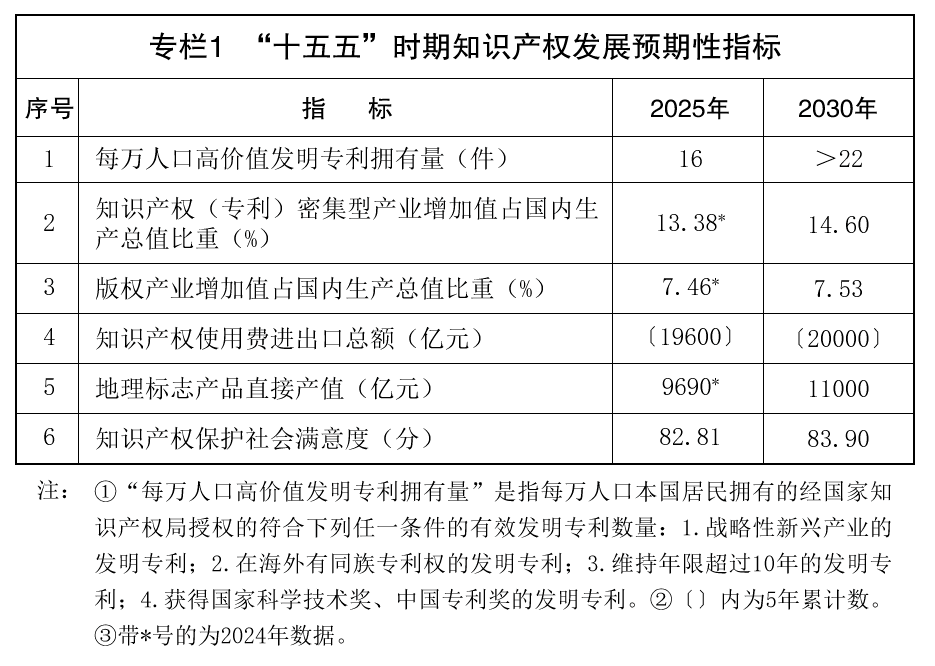
Table 1 shows a 37% growth target to >22 high-value invention patents per 10,000 people. High-value invention patents per 10,000 population are defined as domestically-owned invention patents granted by the Chinese National Intellectual Property Administration meeting any of the following: (1) strategic emerging industry patents; (2) invention patents with counterpart overseas patent family members; (3) invention patents maintained for more than 10 years; (4) invention patents that won national science/technology awards or China Patent Awards.
Other indicators indicate modest growth:
- Indicators 2–3 show modest growth in patent-intensive and copyright industries’ share of GDP (roughly +1.2 and +0.07 percentage points, respectively).
- Indicator 4 targets a 5-year cumulative IP trade (licensing fee import/export) volume of RMB 20,000 亿 (2 trillion), up slightly from the prior period’s RMB 19,600亿.
- Indicator 5 targets geographic indication product direct output value growth from RMB 9,690亿 (2024) to RMB 11,000亿 by 2030.
- Indicator 6 (social satisfaction) targets only a marginal increase (82.81 → 83.90), suggesting this is treated as a maturity/stability indicator rather than a growth target.
The Plan also emphasized trade secret protection:
- Formulate industry-specific/specialized guidelines for trade secret protection rules in key fields.
- Support qualifying regions in building cross-border trade secret rights-protection centers.
- Strengthen guidance and coordination for cross-border trade secret dispute rights protection.
- Guide enterprises to improve risk identification and dispute response capacity for trade secrets in the process of “going global.”
- Promote construction of trade secret protection service stations; build a healthy service network.
- Cultivate a group of specialized, standardized trade secret appraisal institutions; improve appraisal capacity.
- Carry out trade secret management system certification work; promote enterprise-level trade secret management capacity.
Regarding artificial intelligence, the Plan states:
IP promoting AI technical innovation:
- Research patent application/examination guidance for AI-related inventions.
- Timely revise AI-related invention patent examination guidelines; clarify patentable subject matter.
- Timely study virtual reality, digital human, and other digital-domain design protection subject matter; adjust dynamic graphic/UI infringement determination rules.
- Improve copyright systems adapted to AI development.
AI applications in the IP field:
- Deepen multimodal large-model applications in IP fields, including patent/trademark auxiliary examination systems.
- Optimize customs IP infringement risk intelligent identification models.
- Digitize/intelligentize IP administrative enforcement and administrative ruling processes; improve real-time monitoring and source traceability.
- Use AI and big data for university/research institution high-value patent screening and enterprise-patent matching.
- Expand “AI+IP” information service application scenarios, including online publishing, digital reading, and knowledge services.
The full text of the Plan is available here (Chinese only).
