
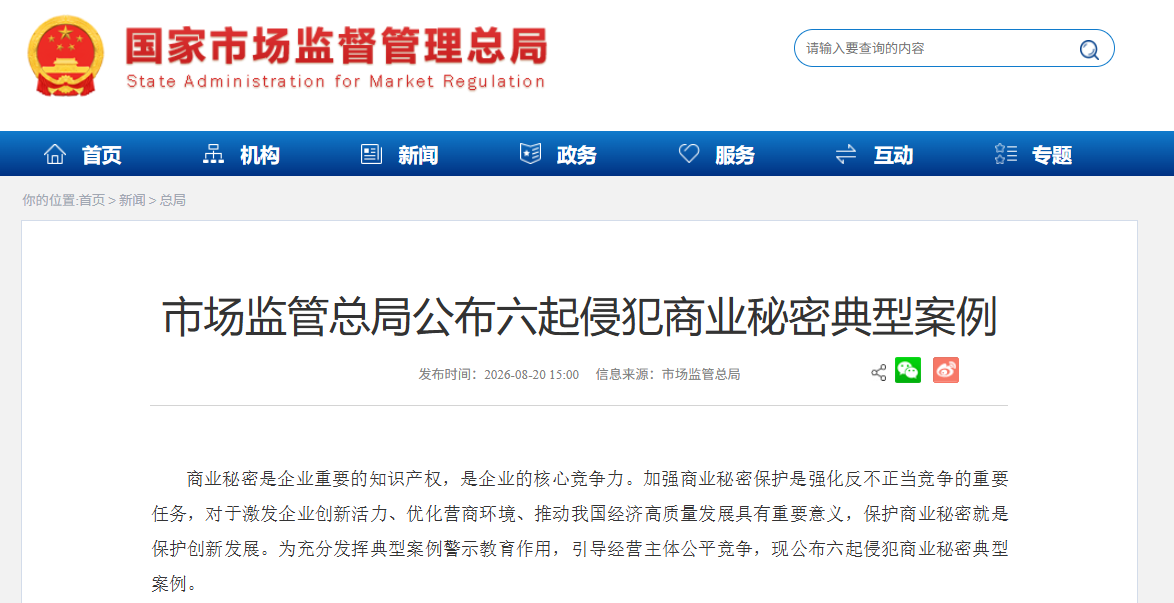
On August 20, 2026, the State Administration for Market Regulation (SAMR) published six typical cases involving infringement of trade secrets, including a case in which SAMR held that prompts, review rules, and annotation specifications used in an AI large-model system can independently constitute trade secrets, separate from any protection attaching to underlying source code. The six cases were released to illustrate enforcement under the Anti-Unfair Competition Law of the People’s Republic of China (as amended in 2019) and to inform business entities about compliance obligations related to trade secret protection.
SAMR and its local market regulation bureaus carry out administrative enforcement of trade secret protections under the Anti-Unfair Competition Law. This administrative enforcement mechanism operates in parallel with civil litigation and criminal prosecution and is not mutually exclusive with those avenues. Administrative enforcement actions by market regulation authorities can result in orders to cease the infringing conduct, confiscation of illegal gains, and fines payable to the government. These proceedings do not result in an award of damages to the party whose trade secret was infringed; a rights holder seeking compensation for losses caused by the infringement must pursue a separate civil action. In several of the six cases published by SAMR, including the case discussed here, administrative penalties were imposed independent of any civil or criminal proceeding that may also apply to the same conduct.
In Case No. 3, the respondent, Sun (孙), joined an unidentified Hangzhou-based artificial intelligence company (referred to as the rights holder) in July 2011 and served as a senior algorithm expert until his departure in July 2025. During his tenure, Sun led research and development of a vertical-domain AI review model and had access to core confidential materials related to that model.
In December 2023, while still employed by the rights holder, Sun registered and controlled a company, Fayuan (Hangzhou) Technology Co., Ltd. (Fayuan), using his spouse’s identity. In June 2024, Sun sent proprietary materials belonging to the rights holder — including prompt templates, review rules, and annotation specifications associated with the AI model — to research personnel at Fayuan. These materials were used by Fayuan to develop an AI model with functions similar to those of the rights holder’s product.
Following review by industry experts, the combination of materials was determined to meet the statutory elements for a trade secret: non-public status, commercial value, and the existence of confidentiality measures by the rights holder. The reviewed materials were characterized as a form of integrated technical information specific to the AI vertical-domain sector.
Sun had signed a specialized confidentiality agreement upon joining the company in July 2011 and, as an employee with access to core confidential information, held confidentiality obligations both during and after his employment. His disclosure of the rights holder’s confidential materials was found to violate Article 9, Paragraph 1, Item (3), and Paragraph 2 of the Anti-Unfair Competition Law (as amended in 2019).
On May 28, 2026, the Hangzhou Market Regulation Bureau, after considering the relevant circumstances, ordered Sun to cease the disclosure and unauthorized use of the information and imposed a fine of RMB 350,000, pursuant to Article 21 of the Anti-Unfair Competition Law. The matter concerning Fayuan’s own conduct in relation to the trade secret infringement is being handled separately. SAMR did not mention if a parallel civil suit is pending.
According to SAMR’s published commentary, this case is identified as the first case at the national level involving trade secret protection specific to a vertical-domain AI large model. Historically, intellectual property enforcement in the AI sector has focused primarily on source code ownership disputes. In this case, the enforcement authority recognized that natural-language-based integrated technical schemes and non-standardized operational rules — including prompt templates — can independently constitute trade secrets, separate from source code.
The full text of SAMR’s typical case release can be found here (Chinese only).
