
China’s National Intellectual Property Administration’s (CNIPA’s) recently released 2025 Intellectual Property Statistical Yearbook records 1,927,500 invention patent applications in 2025, a year-on-year increase of 5.43 percent, and 2,649,201 utility model applications, a year-on-year decrease of 16.81 percent, or approximately 535,000 fewer filings than in 2024.
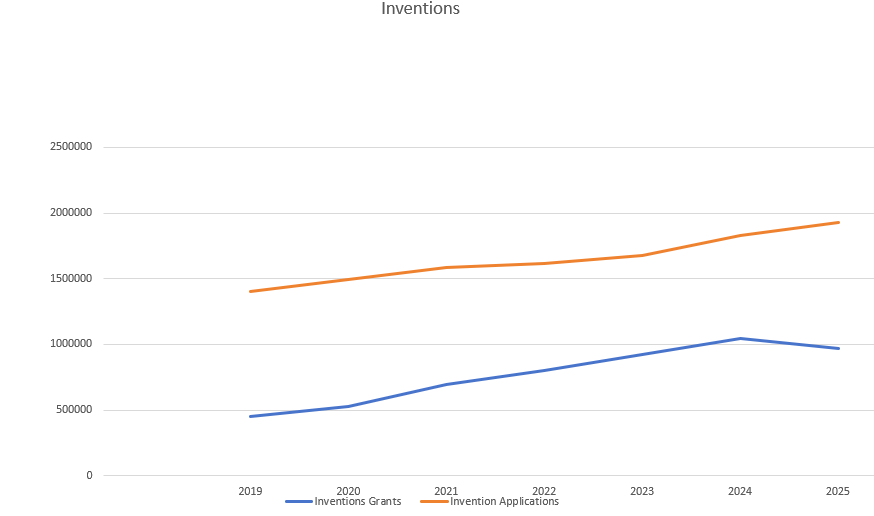
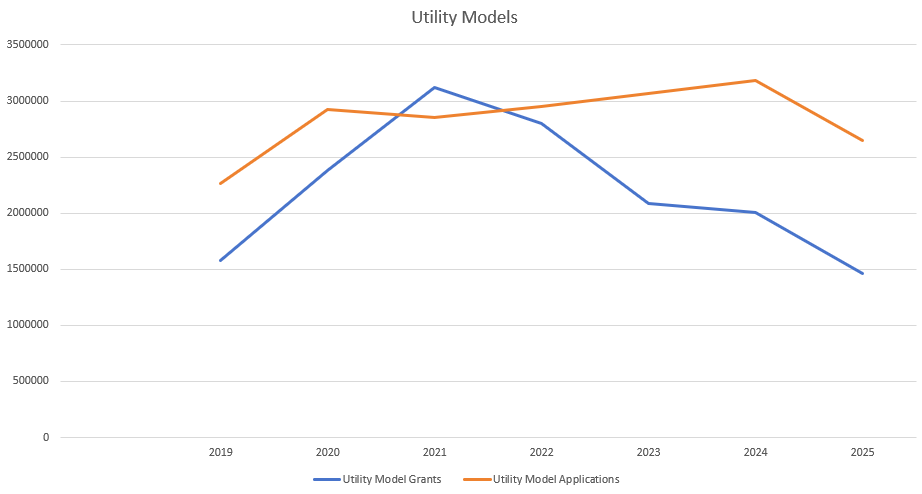
 The two application types moved in opposite directions. Chinese-origin invention filings rose from 1,344,817 in 2020 to 1,672,001 in 2024 and to 1,774,890 in 2025, an increase of about 6.2 percent over the prior year and about 32 percent over the five-year span. Chinese-origin utility model filings fell from 3,178,314 in 2024 to 2,643,090 in 2025, a decrease of about 16.8 percent. The foreign-origin components followed similar directions at smaller volumes: foreign-origin invention filings measured 152,342 in 2020, 156,053 in 2024, and 152,610 in 2025, while foreign-origin utility model filings declined from 7,759 in 2020 to 6,338 in 2024 and 6,111 in 2025.
Japan was the largest foreign filer of Chinese invention patent applications with 47,862 in 2020, 45,201 in 2024, and 43,802 in 2025, a continued decline across the period. In contrast, the United States, at number 2, had 37,880 in 2020, 39,584 in 2024, and 36,743 in 2025, an increase through 2024 followed by a decrease of about 7 percent in 2025.
| Country | 2020 | 2024 | 2025 |
|---|---|---|---|
| Japan (JP) | 47,862 | 45,201 | 43,802 |
| United States (US) | 37,880 | 39,584 | 36,743 |
| Republic of Korea (KR) | 16,725 | 21,040 | 22,774 |
| Germany (DE) | 16,115 | 16,285 | 15,528 |
| France (FR) | 4,887 | 4,637 | 4,765 |
Table: Foreign-origin Chinese invention patent applications by country/region, ranked by 2025 volume.
| Country | 2020 | 2024 | 2025 |
|---|---|---|---|
| Japan (JP) | 2,082 | 1,172 | 1,190 |
| United States (US) | 1,545 | 1,276 | 1,019 |
| Republic of Korea (KR) | 801 | 1,157 | 977 |
| Germany (DE) | 802 | 808 | 864 |
| France (FR) | 400 | 267 | 311 |
Table: Foreign-origin Chinese utility model applications by country/region, ranked by 2025 volume.
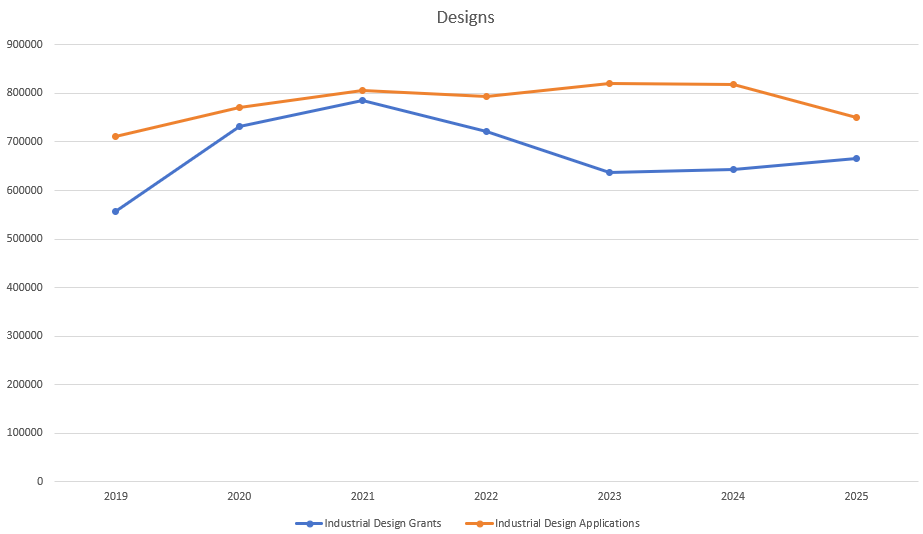
Utility model applications totaled 2,649,201 in China in 2025, exceeding both invention applications (1,927,500) and design applications (750,863). However, foreign-origin utility model filings, which are often overlooked by foreigners, totaled 6,111 filed in 2025, representing approximately 0.2 percent of the utility model total. By comparison, foreign-origin invention filings totaled 152,610 in 2025, representing approximately 7.9 percent of the invention total, and foreign-origin design filings totaled 19,071, representing approximately 2.5 percent of the design total.
Among the five countries listed above, utility model filing volumes are small relative to invention filing volumes from the same countries. Japan filed 43,802 invention applications in 2025 against 1,190 utility model applications. The United States filed 36,743 invention applications against 1,019 utility model applications. The Republic of Korea filed 22,774 invention applications against 977 utility model applications. Germany filed 15,528 invention applications against 864 utility model applications. France filed 4,765 invention applications against 311 utility model applications.
A Chinese utility model application undergoes a formality review rather than a substantive examination for novelty and inventive step, which results in a shorter time to grant relative to an invention application. Enforcement of a utility model right typically involves an evaluation report obtained from CNIPA at the time of enforcement, addressing novelty and inventive step retroactively. The statistics above show the proportion of foreign filings directed to this right relative to invention filings from the same origin countries.
The full dataset is available here.
