
On June 29, 2026, China’s Supreme People’s Procuratorate (SPP) released typical cases punishing malicious intellectual property litigation (最高检发布5件检察机关惩治知识产权恶意诉讼典型案例). The release comprises five cases selected to illustrate procuratorial supervision of bad-faith IP enforcement actions across multiple areas of intellectual property law, including utility model patents, design patents, trademarks, and unfair competition.
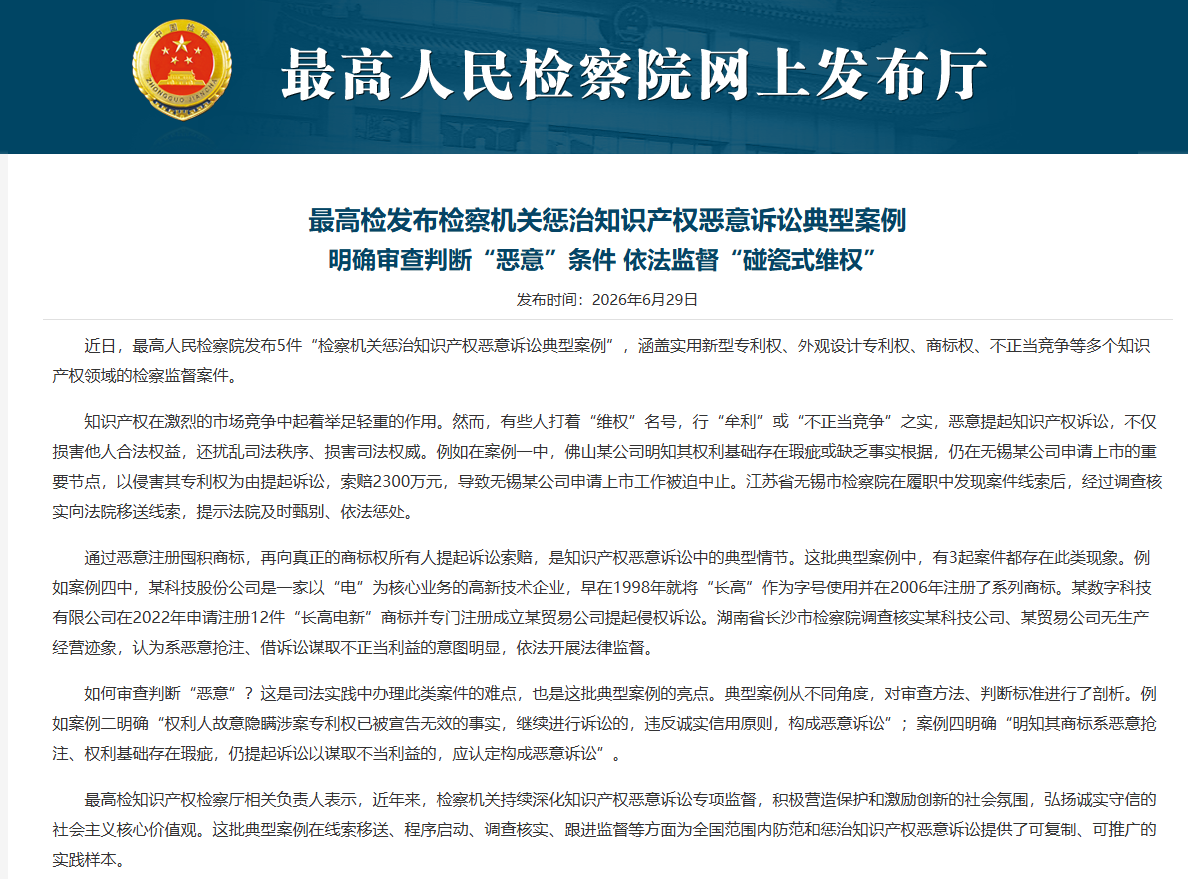 The five cases involve rights holders initiated litigation with knowledge that their rights were defective or lacked factual basis, using the litigation process as a mechanism to extract payments or disrupt competitors rather than to vindicate legitimate IP interests. The conduct addressed in these cases includes filing suit at a strategically damaging moment in a competitor’s IPO process, concealing the invalidation of a patent while continuing to pursue and enforce judgments, registering and stockpiling large numbers of trademarks without any genuine commercial use and then suing active market participants, and misappropriating well-known cultural and tourism identifiers associated with a city’s public heritage for use as litigation instruments.
The release serves two purposes. First, it provides guidance to procuratorates nationwide on the procedural mechanisms available for supervising malicious IP litigation, including ex officio initiation of supervision, evidence referral to courts during pending proceedings, issuance of retrial procuratorial recommendations, and protest (抗诉) to higher courts where lower courts decline to act. Second, it articulates standards for identifying the “malicious” element that distinguishes abusive litigation from ordinary unsuccessful enforcement, drawing on factors such as the validity of the rights asserted, the absence of actual infringement, the plaintiff’s awareness of defects in its rights, the volume and pattern of filings, the absence of genuine business operations, and the timing and amount of claims relative to the defendant’s circumstances.
A translation the SPP Explanation of the Typical Cases follows. The original text is available here (Chinese only).
Case 1
A case of malicious litigation supervision by the procuratorate in a dispute over infringement of utility model patent rights between a Foshan intelligent equipment company and a Wuxi mechanical technology company.
【Keywords】
Malicious litigation, disputes involving infringement of utility model patent rights, in-process supervision, and referral of clues.
[Basic Case Facts]
Wuxi XX Machinery Technology Co., Ltd. (hereinafter referred to as Wuxi Company) mainly engages in the research, development, production, and sales of automated material handling systems such as metering and batching. Its products are widely used in chemical, food, and pharmaceutical industries. The company holds over 100 patents and software copyrights and is a Jiangsu Provincial High-Tech Enterprise and a specialized and innovative “Little Giant” enterprise. Foshan-based Intelligent Equipment Co., Ltd. (hereinafter referred to as Foshan Company) mainly engages in the manufacturing of new energy equipment and chemical new material equipment. The two companies have similar products and patents in the same field and have repeatedly competed in the same projects, thus exhibiting a competitive relationship.
In August 2019, a company in Foshan obtained a utility model patent for “a mixing device.” On January 10, 2023, the Foshan company filed a lawsuit against a Wuxi company in the Intermediate People’s Court of Wuxi City, Jiangsu Province for infringing its patent rights, seeking damages of 23 million yuan. This amount exceeded 10% of the absolute value of the Wuxi company’s net assets (227.6 million RMB) disclosed at that time, thus constituting a lawsuit that should be disclosed under the “Information Disclosure Rules for Listed Companies on the National Equities Exchange and Quotations (NEEQ)”. At this time, the stock exchange had only accepted the Wuxi company’s listing application for more than ten days, forcing the Wuxi company’s listing process to be suspended.
[Performance of duties by the procuratorial organs]
Discovery and Verification of Evidence. In March 2023, the Wuxi Municipal People’s Procuratorate of Jiangsu Province (hereinafter referred to as the Wuxi Procuratorate) discovered evidence to a case during the performance of its duties. Leveraging its integrated performance advantages, the Wuxi Procuratorate coordinated with the grassroots procuratorates in the jurisdiction where the company was located to conduct the following investigation and verification work: First, verifying the rights basis of the Foshan company. On November 23, 2022, upon application by the Foshan company, the China National Intellectual Property Administration issued an evaluation report on the patent in question, determining that all claims did not meet the conditions for granting patent rights. Second, verifying whether the Wuxi company had committed infringement. It was found that the patent application date was August 2019, and the Wuxi company had already commissioned a supplier to manufacture the same product in June 2018. Therefore, the Wuxi company did not commit any infringement. Third, considering the competitive relationship between the two parties, the litigation situation, the timing of the lawsuit filed by the Foshan company, and the amount of compensation claimed, it was determined that the Foshan company acted maliciously. Fourth, it was found that the lawsuit filed by the Foshan company caused the Wuxi company’s listing activities to be suspended, resulting in damages.
Supervisory Opinion. On April 12, 2023, the Wuxi Municipal People’s Procuratorate transferred the case to the Wuxi Intermediate People’s Court, clarifying the facts and reasons that the case constituted malicious litigation, and reminding the court to promptly identify and punish such actions according to law. At the same time, the procuratorate explained the relevant legal provisions to a certain company in Wuxi, which then chose to protect its rights by filing a counterclaim.
Supervision Results. In April 2023, the Wuxi Intermediate People’s Court held a public hearing and delivered its verdict in court, dismissing the lawsuit filed by the Foshan company and ordering it to pay the Wuxi company reasonable expenses of 400,000 RMB and publish a public statement on the China Capital Market Service Platform to mitigate the negative impact. After the Foshan company appealed, the Supreme People’s Court issued a second-instance judgment in June 2024, rejecting the appeal and upholding the original judgment. The Wuxi company officially went public in December 2023. During the handling of the case, the Wuxi Municipal People’s Procuratorate proactively communicated and consulted with the Wuxi Intermediate People’s Court, reaching a consensus on how to effectively punish malicious litigation, promptly protect the legitimate rights and interests of enterprises, prevent the further expansion of the adverse effects of malicious litigation, and safeguard the healthy development of enterprises.
[Typical Significance]
Knowing that the legal basis of a business competitor’s rights is flawed or lacks factual basis, and still initiating litigation at crucial junctures such as a business competitor’s IPO application to seek illegitimate gains, constitutes malicious litigation, harming the legitimate rights and interests of others and disrupting litigation order. When handling cases involving supervision of malicious litigation, the procuratorate should adhere to a penetrating approach, comprehensively investigating and verifying whether the intellectual property rights basis is stable, whether infringement has occurred, and whether the plaintiff was aware of the flaws in the legal basis, their litigation motives, and the timing of the lawsuit. For intellectual property cases still under trial in the people’s courts, if the procuratorate, upon review, finds that malicious litigation has occurred, it may transfer clues to the people’s courts to alert them to abnormal situations, punish malicious litigation according to law, effectively safeguard judicial fairness and authority, and promote the construction of a social credit system.
Case 2
Case of Malicious Litigation by He XX in Dispute over Infringement of Design Patent Rights with Yiwu XX Import and Export Co., Ltd.
【Keywords】
Malicious litigation, disputes over infringement of design patent rights, patent invalidation, appeals.
[Basic Case Facts]
On May 31, 2017, He obtained a design patent for shapewear from the China National Intellectual Property Administration (CNIPA). He purchased multiple items identical or similar to those in question through an online platform, and notarized the entire purchase process. From October 2018 to April 2019, He filed multiple lawsuits against the sellers of the relevant products, alleging infringement of his design patent. On October 11, 2018, He filed this lawsuit against Yiwu XX Import & Export Co., Ltd. . On August 16, 2019, the Hangzhou Intermediate People’s Court of Zhejiang Province ruled that the design patent in question was legally valid and that the allegedly infringing products sold by Yiwu XX Company fell within the scope of protection of the patent, constituting infringement. The court ordered Yiwu XX Company to cease infringement and compensate for economic losses and reasonable expenses incurred in stopping the infringement, totaling 10,000 RMB. Neither party appealed, and the judgment became effective.
[Performance of duties by the procuratorial organs]
Discovery and Investigation of Evidence. In June 2023, the Hangzhou Municipal People’s Procuratorate of Zhejiang Province (hereinafter referred to as the Hangzhou Procuratorate) received case evidence transferred from the Suzhou Municipal People’s Procuratorate of Jiangsu Province. After screening, five pieces of evidence of malicious litigation, including this case, were discovered, and the procuratorate initiated supervisory procedures ex officio. The Hangzhou Procuratorate’s investigation revealed that Zhao, an unrelated party, filed a request with the State Intellectual Property Office in January 2019 to invalidate the patent in question. He submitted a written statement of opinion and participated in an oral hearing with the CNIPA. On July 3, 2019, the CNIPA issued a “Decision on Examination of Invalidation Request,” declaring the entire design patent in question invalid. This decision was sent to He by registered mail on July 10. Dissatisfied with the invalidation decision, He filed an administrative lawsuit with the Beijing Intellectual Property Court in September 2019. The court dismissed He’s lawsuit in the first instance. He appealed, and the Supreme People’s Court issued a second-instance judgment in March 2021, dismissing the appeal and upholding the original judgment.
Supervisory Opinion. On December 29, 2023, the Hangzhou Municipal People’s Procuratorate requested the Zhejiang Provincial People’s Procuratorate to file a protest. On July 4, 2024, the Zhejiang Provincial People’s Procuratorate filed a protest with the Zhejiang Provincial Higher People’s Court (hereinafter referred to as the Zhejiang Higher Court), arguing that He XX, knowing that the design patent right he sought to protect had been declared invalid by the CNIPA, deliberately concealed this fact during the litigation process, obtained five effective judgments, and applied for enforcement, violating the principle of good faith and constituting malicious litigation. The court further argued that there was new evidence sufficient to overturn the effective judgments.
Supervision Results. On November 12, 2024, the Zhejiang High People’s Court adopted the appeal opinion, ruled to overturn the original judgment, and dismissed He’s lawsuit. At the same time, the Zhejiang High People’s Court held that He’s failure to truthfully disclose the fact that the patent right in question had been declared invalid led to an erroneous judgment by the People’s Court, constituting obstruction of civil litigation, and imposed a fine of 50,000 RMB on him, which He has already paid.
[Typical Significance]
According to Article 2 of the “Interpretation (II) of the Supreme People’s Court on Several Issues Concerning the Application of Law in the Trial of Patent Infringement Disputes,” if a patent claim asserted by the patentee in a patent infringement lawsuit is declared invalid by the patent administration department under the State Council, the people’s court hearing the patent infringement dispute may rule to dismiss the patentee’s lawsuit based on the invalid claim. If there is evidence proving that the decision declaring the aforementioned claim invalid has been revoked by an effective administrative judgment, the patentee may file a separate lawsuit. Therefore, whether before or during litigation, if the patent in question is declared invalid by the CNIPA, the patentee should promptly inform the people’s court; this is an essential aspect of the principle of good faith. If the patentee intentionally conceals the fact that the patent in question has been declared invalid and continues litigation, it violates the principle of good faith and constitutes malicious litigation, which should be supervised by the procuratorate.
Case 3
A case of malicious litigation by a Shenzhen-based investment company versus a Wenzhou-based home furnishing company and Mr. He regarding trademark infringement, under the supervision of the procuratorate.
【Keywords】
Malicious litigation, trademark infringement disputes, the principle of good faith, follow-up supervision, and appeals.
[Basic Case Facts]
A Shenzhen-based investment company obtained trademark registration No. 19188109, “ “, for use on goods such as pillows in Class 20, with a registration validity period from April 7, 2017 to April 6, 2027. On November 30, 2018, an authorized agent of Shenzhen Company, accompanied by a notary, went to the business premises of a Wenzhou-based home furnishing company and purchased 24 latex pillows, 6 pillowcases, and 8 cardboard gift boxes as a consumer. Two of the latex pillows were printed with the ” ” mark. On May 28, 2019, the Shenzhen Company filed this lawsuit in the Ruian People’s Court of Zhejiang Province against the Wenzhou Company and its legal representative, Mr. He, for infringing its trademark rights.
On August 28, 2019, the Ruian City Court issued a first-instance judgment, finding that a Wenzhou company’s sale of latex pillows bearing the “ ” logo infringed upon the registered trademark rights of a Shenzhen company. The court ordered the company to cease the infringement and pay 75,000 RMB in damages and reasonable expenses, with He XX bearing joint liability. Neither party appealed the judgment.
[Performance of duties by the procuratorial organs]
Discovery and Investigation: The Ruian Municipal People’s Procuratorate (hereinafter referred to as the Ruian Procuratorate) discovered an unusual lead regarding the Shenzhen company’s bulk rights protection activities during the course of its duties. After reviewing relevant litigation files, searching the Shenzhen company’s litigation data, and verifying with the market supervision and management department, it was found that the Shenzhen company had applied for registration of over 600 trademarks in different product categories and had sued multiple latex product companies in Zhejiang Province since 2019, potentially constituting malicious litigation. The Ruian Procuratorate conducted an on-site investigation of the Shenzhen company’s production and operation, finding that the company had no actual production or operation site, no production or operation activities, and lacked the conditions for production and operation; its registered trademarks were not actually used for production and operation activities. Furthermore, the trademarks in question had been declared invalid by the China National Intellectual Property Administration (CNIPA) at the request of a third party, and the Shenzhen company filed an administrative lawsuit on December 28, 2022. On March 27, 2024, the Beijing Intellectual Property Court rejected the Shenzhen company’s lawsuit in the first instance. On August 9 of the same year, the Beijing Higher People’s Court upheld the first instance judgment in the second instance. Based on the facts regarding the production and operation of a certain Shenzhen company, the number of trademark registrations, the number of lawsuits filed, and the motives for the lawsuits, it can be determined that the Shenzhen company maliciously filed the lawsuits.
Supervisory Opinion. On April 26, 2023, the Ruian Municipal People’s Procuratorate issued a “Retrial Procuratorial Recommendation” to the Ruian Municipal People’s Court. The Ruian Municipal People’s Court did not adopt the retrial procuratorial recommendation on the grounds that the administrative litigation concerning the trademark in question had not yet reached a final judgment. On November 7, 2024, the Ruian Municipal People’s Procuratorate requested the Wenzhou Municipal People’s Procuratorate to file a protest. On January 3, 2025, the Wenzhou Municipal People’s Procuratorate filed a protest with the Wenzhou Intermediate People’s Court, arguing that the Ruian Municipal People’s Court’s first-instance judgment was based on erroneous facts and that there was new evidence sufficient to overturn the judgment.
Supervision Results. On September 2, 2025, the Wenzhou Intermediate People’s Court issued a retrial judgment, overturning the first-instance judgment of the Ruian Municipal People’s Court and dismissing the lawsuit filed by a Shenzhen company.
[Typical Significance]
If a trademark registrant registers and hoards a large number of trademarks without using them for actual production and operation, intending to gain improper benefits through litigation, this violates the principle of good faith and disrupts litigation order, and should be considered malicious litigation. When handling cases of supervision against malicious litigation, the procuratorate should actively utilize big data screening to identify case leads, focusing on whether the plaintiff acted maliciously. It should strengthen the investigation and verification of facts such as the trademark registrant’s production and operation, the number and motives of lawsuits filed, and the registration and use of trademarks, comprehensively considering multiple factors to determine whether it constitutes seeking improper benefits through litigation. In cases of supervision against malicious litigation, if the people’s court does not adopt the procuratorate’s suggestion for retrial, and the superior procuratorate, after review, finds that the case meets the conditions for follow-up supervision, it should file a protest according to law to ensure the quality and effectiveness of supervision.
Case 4
A case of malicious litigation and prosecutorial supervision in a trademark infringement and unfair competition dispute between a digital technology company and a technology corporation.
【Keywords】
Malicious litigation, trademark infringement, unfair competition disputes, ex officio supervision, prosecutorial recommendations.
[Basic Case Facts]
XX technology company was established in 1998 and listed on the Shenzhen Stock Exchange in July 2010. It is a high-tech enterprise with “electricity” as its core business. As early as 1998, it used “Changgao” as its trade name. Starting in 2006, it successively registered the “Changgao” series of trademarks on goods related to power equipment in Class 9.
A digital technology company (hereinafter “Digital Company”) applied for registration of 12 trademarks for “Changgao Electric New Energy” in multiple categories of goods and services, including classes 4, 7, 9, 16, 35, 36, 37, 38, 39, 40, and 42, on March 22, March 29, and April 1, 2022, respectively. On September 1, 2022, the Technology Company established a certain international trading company (hereinafter referred to as “the Trading Company”) with the “Changgao Electric New Energy” trademark as intellectual property.
In November 2022, the Digital company and a trading company filed a lawsuit in the Changsha Intermediate People’s Court of Hunan Province against the Technology company for infringing on their trademark rights and engaging in unfair competition, requesting the court to order the joint-stock company to cease infringement and compensate for losses of 10 million yuan.
[The process of the procuratorial organs performing their duties]
Discovery and Investigation of Evidence. The Changsha Municipal People’s Procuratorate (hereinafter referred to as the Changsha Procuratorate) discovered clues suggesting the Digital company and trading company were suspected of malicious litigation during the course of its duties. After preliminary review, the Changsha Procuratorate determined that this might constitute malicious litigation and accepted the case ex officio on March 27, 2023, focusing on the following investigations: First, verifying the development of the technology company and its use of its trade name. Second, verifying the actual business operations of the technology company and the trading company. On-site visits revealed that the Digital company’s registered address was closed, showing no signs of production or operation; the trading company’s registered address was a shop address with no production facilities; neither company had any employees with social insurance records; and their products did not conform to relevant industry standards. Third, verifying the trademark registration of the Digital company and the trading company, it was found that the technology company applied for registration of 129 trademarks from March 7, 2021 to November 7, 2022, most of which were for goods categories outside its business scope. Fourth, an investigation was conducted into trademark disputes involving the Digital company and trading company, as well as instances where their trademarks or trade names were identical or similar to those of other companies. It was found that other trademarks applied for registration by the Digital company were identical or similar to the trade names of several companies, including a Shanxi-based hotel company and a Chinese equipment group, and the registration dates highly overlapped with the company name changes. Fifth, the motives for initiating the lawsuit were examined. The day after the Technology company announced its name change to “Changgao Electric New Energy,” the Digital company applied for and registered the “Changgao Electric New Energy” trademark, obtained registration in September, and then filed this lawsuit in November, seeking damages of up to 10 million RMB. The intent to gain illicit profits through litigation is evident.
Supervisory Opinion. The Changsha Municipal People’s Procuratorate, after review, determined that the Digital company and trading company maliciously registered the “Changgao Electric New Energy” trademark without the intention of using it, and that the basis for their rights was clearly flawed. After the malicious registration, the two companies sued the Technology company, alleging infringement and unfair competition, and requesting substantial compensation, intending to obtain undue profits. This violated the principle of good faith and constituted malicious litigation. On September 13, 2023, the Changsha Municipal People’s Procuratorate transferred the case to the Changsha Intermediate People’s Court, indicating that the Digital company and the trading company were suspected of malicious litigation and recommending appropriate penalties.
Supervision Results. On December 21, 2023, the Changsha Intermediate People’s Court determined that the Digital company and trading company had engaged in malicious litigation, dismissed the lawsuit in court, and imposed a fine of 100,000 RMB on them for their malicious litigation behavior in Decision No. (2023)湘01司惩4号. The Digital company and the trading company disagreed and applied for reconsideration to the Hunan Provincial Higher People’s Court. On January 23, 2024, the Hunan Provincial Higher People’s Court issued a reconsideration decision, rejecting the reconsideration application and upholding the original decision. Meanwhile, through communication and cooperation among the procuratorate, the court, and the Changsha Intellectual Property Office, the China National Intellectual Property Administration declared 72 registered trademarks applied for by the Digital company, the trading company, and their affiliated companies invalid.
[Typical Significance]
If a party knowingly initiates litigation to seek undue gains by knowing that a trademark has been maliciously registered or that its legal basis is flawed, it should be deemed to have committed malicious litigation. Malicious litigation not only harms the legitimate rights and interests of others but also disrupts judicial order, damages judicial authority, undermines the construction of a social credit system, and harms the public interest. When procuratorial organs discover clues to malicious litigation cases in the course of their duties, they should initiate supervisory procedures ex officio, in accordance with Article 37, Paragraph 1 of the “Rules of the People’s Procuratorate for Civil Litigation Supervision.” For cases that have already been adjudicated and support the plaintiff’s claims, a protest or a recommendation for retrial should be filed against the effective judgment in accordance with the law. For cases that have not yet been adjudicated, clues to suspected malicious litigation cases should be promptly transferred to the court, recommending that the court conduct a prudent trial and identify the case according to law.
Case 5
A case of malicious litigation by a Chongqing-based information technology company against a Chengdu-based travel agency in a trademark infringement dispute, subject to prosecutorial supervision.
【Keywords】
Malicious litigation, trademark infringement disputes, investigation and verification, and referral of leads.
[Basic Case Facts]
The night view of the “Two Rivers Cruise” in Chongqing has been one of the “Twelve Scenic Spots of Bayu” since the Qianlong era, and is one of Chongqing’s most distinctive urban cultural and tourism attractions. The “Two Rivers Cruise” project has an average annual passenger volume of over 3 million. “Jiaoyun Mingyue” and “Shiji Huihuang” are the names of the “Two Rivers Cruise” boats. Two local Chongqing companies have been using these names as commercial logos on the “Two Rivers Cruise” boats and tourism transportation services since 2016, and have long promoted them, gaining a certain degree of recognition within the industry.
A Chongqing-based information technology company (hereinafter referred to as Chongqing Company) was established on December 10, 2014. Its main business is website development, with a secondary focus on tourism. Starting in 2017, the company repeatedly applied for trademark registration for numerous marks related to the “Two Rivers Tour” in multiple categories, including Class 12 (trademarks for the sale of motorized vehicles such as boats and ferries) and Class 39 (trademarks for yacht and boat rental services). After trademark registration, the company continuously collected information on tourism companies operating “Two Rivers Tour” ticketing services on relevant tourism platforms. Claiming infringement of its trademark rights, it filed seven lawsuits against several tourism companies, including a Chengdu-based travel agency, in the Yuzhong District People’s Court of Chongqing (hereinafter referred to as the Yuzhong District Court), demanding cessation of infringement and compensation for losses. This resulted in some tourism companies removing “Two Rivers Tour” ticketing services from their platforms, harming the legitimate rights and interests of unspecified operators and consumers, and disrupting the tourism market order.
[Performance of duties by the procuratorial organs]
Discovery and Investigation of Evidence. In November 2023, some tourism companies reported to the Yuzhong District People’s Procuratorate of Chongqing Municipality (hereinafter referred to as the Yuzhong District Procuratorate) that the Chongqing company had engaged in unfair competition. After review, the Yuzhong District Procuratorate believed that the Chongqing company might have maliciously applied for registration, hoarded trademarks, and filed lawsuits. After accepting the case, the Yuzhong District Procuratorate focused on the following investigation and verification work: First, by interviewing relevant parties and visiting cultural and tourism departments, it was found that the “Two Rivers Tour” series of logos had been registered and used by the ship inspection department and had a certain degree of popularity. Second, based on the relevant business transaction records and trademark authorization usage instructions provided by the Chongqing company, it was found that the business transaction records “trademark licensing fee” transactions were fabricated and created for the purpose of filing lawsuits, and the Chongqing company did not use the aforementioned trademarks for production and operation. Third, it was found that the Chongqing company had preemptively registered and hoarded the “Two Rivers Tour” related logos, attempting to seize public resources and seriously disrupting the order of trademark registration management; the company abused its right to sue and filed lawsuits against unspecified competitors, seriously disrupting the competitive order of the tourism market.
Supervisory Opinion. The Yuzhong District Procuratorate, after review, determined that a certain Chongqing company maliciously applied for and hoarded trademarks, abusing its litigation rights to infringe upon the interests of its competitors, and should be deemed to have committed malicious litigation. On January 8, 2024, the Yuzhong District Procuratorate transferred the case to the Yuzhong District Court.
Supervision Results. On January 25, 2024, the Yuzhong District Court issued a first-instance judgment in a trademark infringement dispute case between the Chongqing company and the Chengdu travel agency. The court ruled that the Chongqing company’s actions constituted a typical abuse of rights and malicious litigation, and dismissed all of the company’s claims. Simultaneously, the court also dismissed the claims in six other cases filed by the Chongqing company.
[Typical Significance]
Well-known cultural and tourism symbols of a city carry the historical and cultural connotations of a specific region and possess the attributes of public resources. Maliciously registering well-known cultural and tourism symbols or commercial symbols previously used by others, and then using this information to file lawsuits for illegitimate gains, constitutes malicious litigation, seizing public resources, damaging fair competition, and hindering the healthy development of the city’s tourism economy. When handling such cases, the procuratorate should fully utilize its investigative and verification powers to ascertain whether the relevant commercial symbols were previously used, the trademark registrant’s production and operational capabilities, whether the registered trademark was actually used, and the scope, number, and subjective purpose of the lawsuits filed. A comprehensive review should then be conducted to determine whether the perpetrator has engaged in the aforementioned malicious litigation behavior.
