
China has the largest volume of generative artificial intelligence (GenAI) patenting activity in the world, according to a report published July 14, 2026 by the World Intellectual Property Organization (WIPO). The findings, detailed in WIPO’s Technology SPARK Report, “Patent Trends Update in GenAI,” extend the analysis from WIPO’s 2024 Patent Landscape Report on Generative Artificial Intelligence through the end of 2025.
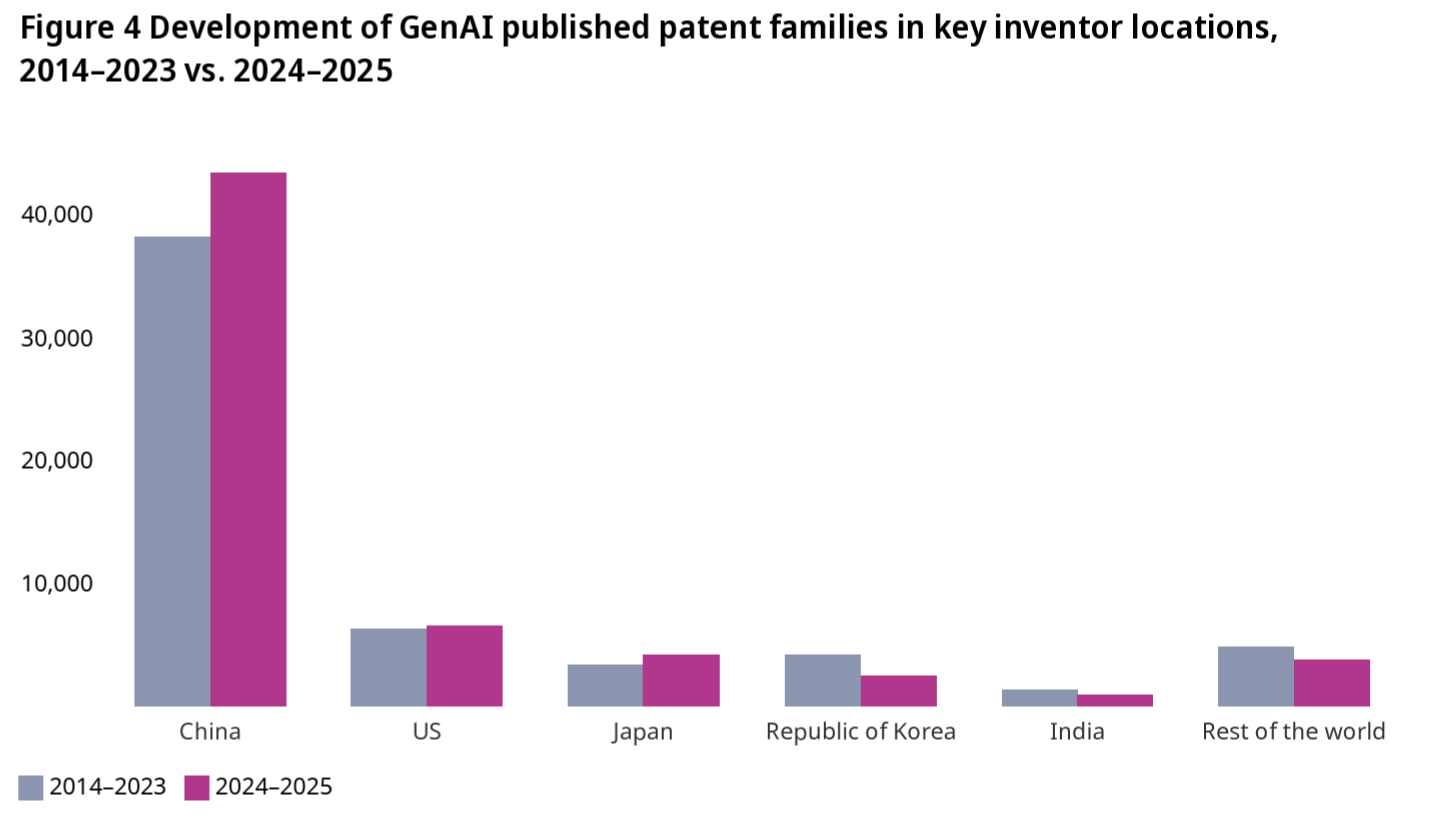
China-based inventors published over 43,000 GenAI patent families in 2024 and 2025 combined, exceeding the country’s cumulative output from 2014 to 2023. China’s compound annual growth rate (CAGR) for GenAI patent families was 64% between 2023 and 2025. Among the top inventor locations globally, China ranks first by a substantial margin. The top four inventor locations (China, the United States, Japan and the Republic of Korea) together account for the majority of global GenAI patent family publications.
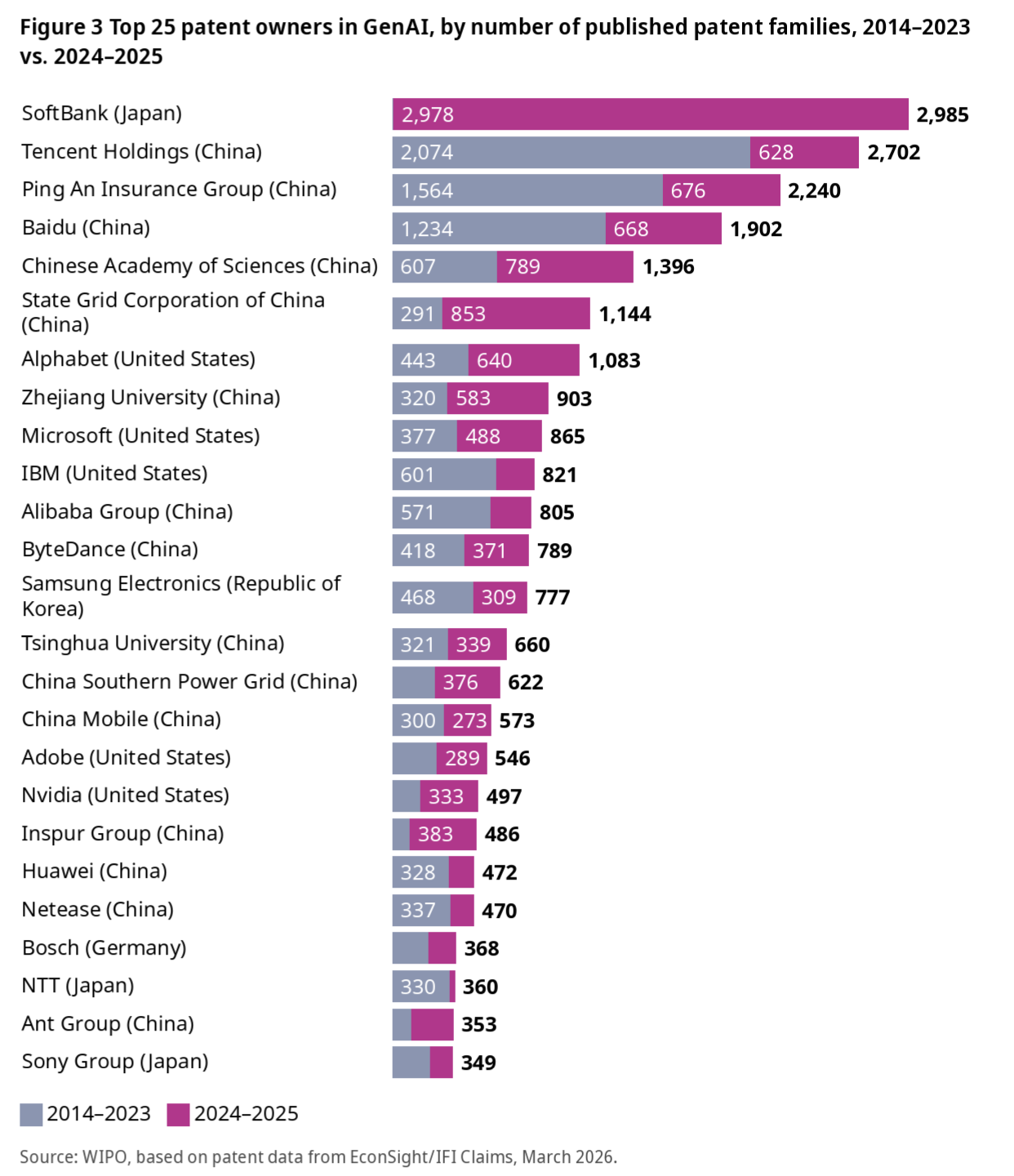
Six of the world’s top ten GenAI patent applicants are based in China. Tencent Holdings (2,702 patent families), Ping An Insurance Group (2,240) and Baidu (1,902) remain among the largest cumulative patent owners globally, having led the rankings in the original 2024 report. The Chinese Academy of Sciences (1,396 patent families) is the leading research institution in the field, and State Grid Corporation of China has 1,144 patent families, of which 853 were published in 2024 and 2025. Zhejiang University (903) has also risen in the rankings. Additional Chinese entrants in the top 25 include China Southern Power Grid, Inspur Group, and Ant Group, spanning sectors including energy, cloud infrastructure and fintech.
US GenAI patent families rose from approximately 1,185 in 2023 to over 4,380 in 2025, reflecting a 92% CAGR over that period, a growth rate higher than China’s. The report states that this reflects commercial GenAI development by US companies translating into patent activity, though the total volume remains below China’s output.
Alphabet (Google) is the largest US-based GenAI patent owner, with 1,083 patent families and 640 filed in 2024 or 2025. Microsoft (865) and IBM (821) follow in second and third places among US companies, though IBM’s recent filing rate (220 in 2024–2025) is comparatively lower. Nvidia (497 patent families, with 333 in 2024–2025) is a new entrant in the top 25, reflecting its expansion beyond GPU hardware into AI software and model architectures.
Chinese firms and institutions hold more positions in the global top 25 patent owners than US companies, in both cumulative and recent filing counts. SoftBank, a Japanese company, is the single largest GenAI patent holder overall, with nearly 3,000 patent families published almost entirely in 2025. This has not changed China’s position as the leading source of GenAI patent publications by volume.
According to WIPO, published GenAI patent families rose from approximately 14,000 in 2023 to over 37,800 in 2025, with more than 56,000 new GenAI patent families published in 2024 and 2025 combined, exceeding the cumulative output of the 2014–2023 period. GenAI accounts for 8.7% of all AI-related patent family publications, up from 6.1% in 2023 and 4.2% in 2017.
WIPO Director General Daren Tang stated that “Gen-AI patents are no longer just being filed by tech companies but also by large enterprises in areas like finance, telecommunications, infrastructure and other digital services.” This pattern is reflected in China’s patent portfolio, which includes internet platforms (Tencent, Baidu, ByteDance, Alibaba), insurance (Ping An), utilities (State Grid Corporation of China, China Southern Power Grid), telecommunications (China Mobile) and research institutions (Chinese Academy of Sciences, Zhejiang University, Tsinghua University).
The report notes that several countries, including the United States, Japan, Germany, Canada and Switzerland, posted CAGR figures above 80%, narrowing the gap with China in relative growth terms, while China continues to lead in absolute volume.
Source: World Intellectual Property Organization (WIPO) (2026). Patent Trends Update in GenAI. Geneva: WIPO. DOI 10.34667/tind.60252
