
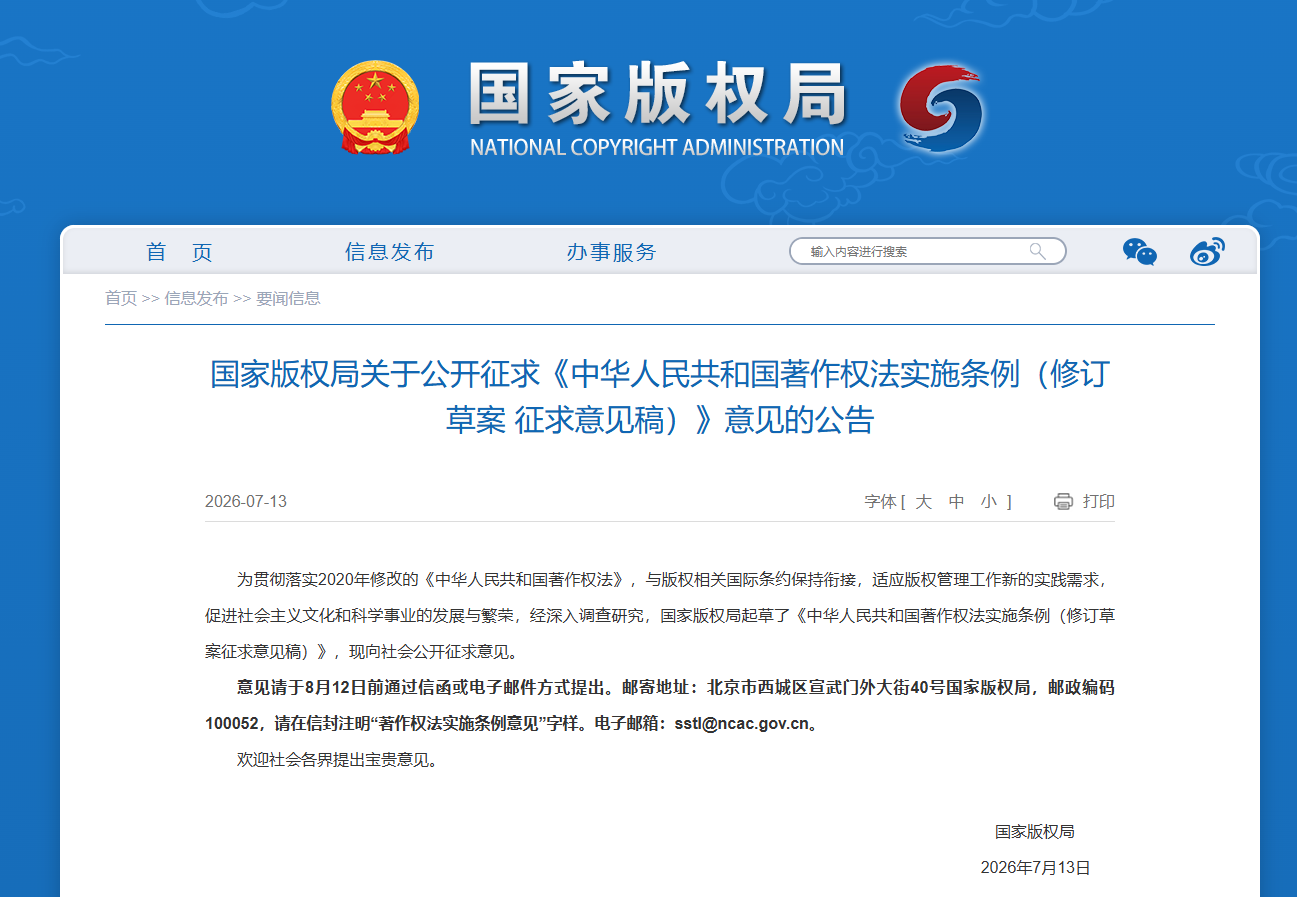
On July 13, 2026, China’s National Copyright Administration (NCA) released the Implementing Regulations of the Copyright Law of the People’s Republic of China (Revised Draft for Public Comment) (中华人民共和国著作权法实施条例(修订草案征求意见稿)) for public consultation. Comments may be submitted by mail or email through August 12.
 The current Implementing Regulations were last revised in 2013 and no longer align with the legal framework they are meant to support. Two developments prompted the update.
First, the third amendment to the Copyright Law was completed in November 2020 and took effect in June 2021. That amendment reorganized the rights system, refined the authorization and transaction rules for copyright and related rights, and strengthened enforcement. As the primary administrative regulation implementing the Copyright Law, the Implementing Regulations require conforming changes in both substance and cross-referencing.
Second, two international treaties have entered into force for China: the Beijing Treaty on Audiovisual Performances and the Marrakesh Treaty (facilitating access to published works for persons who are blind, visually impaired, or otherwise print-disabled). The Copyright Law was amended to accommodate these obligations, and the draft refines the Implementing Regulations to give effect to them — for example, by expanding the definition of performers and by defining reading-disabled persons and accessible formats.
The draft expands the current 38 articles to 49 articles. Several changes stand out.
Technology-neutral definition of audiovisual works
Draft Article 3(xi) replaces the former category of “cinematographic works and works created by methods analogous to filmmaking” with a broader, technology-neutral category of “audiovisual works” (视听作品). The new definition covers works “fixed on a certain medium by any means, consisting of a series of moving images with or without accompanying sound, and projected or disseminated by other means using appropriate devices.”
The draft further clarifies that audiovisual works include films, television dramas, featurettes, documentaries, animated works, web series, and variety programs. By moving away from a definition tied to the method of “filmmaking,” the revised category more readily accommodates online and new-media content that did not fit comfortably within the earlier language.
Presumption of ownership from attribution
Draft Article 9 introduces a presumption of ownership: a natural person, legal person, or unincorporated organization whose name appears on a work is presumed to be the copyright owner, unless there is evidence to the contrary. The current regulations contain no comparable standalone provision. Codifying the presumption gives evidentiary weight to attribution and may reduce the burden of proving ownership in disputes and enforcement proceedings.
Deletion of the fixed fine schedule
The draft removes the fixed fine schedule in current Article 36, which set penalties tied to illegal turnover for infringement that also harmed the public interest. In its place, draft Article 47 addresses enforcement jurisdiction and sets out an enumerated list of circumstances that constitute harm to the public interest — such as harm to national image or public security, disruption of the market economic order, disruption of cultural market order, and profit-motivated or habitual infringement. The shift moves from a prescribed penalty formula toward a qualitative framework for identifying public-interest harm.
New attribution and remuneration rights for performers in audiovisual works
Draft Article 35 addresses performers whose performances are embedded in films and television dramas. The rights to such performances belong to the producers; however, performers retain the right to identify themselves as the performer and the right to protect their performance from distortion, and are entitled to remuneration in accordance with the contract signed with the producers. This provision has no standalone counterpart in the current regulations and reflects the performer-protection principles of the Beijing Treaty on Audiovisual Performances.
New framework for technical protection measures and rights management information
The draft adds four entirely new articles — 43 through 46 — establishing a framework for technical protection measures and rights management information, matching provisions strengthened in the 2020 Copyright Law amendment.
Draft Article 43 defines “technical measures” as effective technologies, devices, or components used to prevent or restrict unauthorized copying and dissemination of works, performances, sound and video recordings, or broadcasts, or unauthorized operation of computer software, and requires rights holders to mark the relevant details when using such measures.
Draft Article 44 creates a circumvention exception for qualifying users. Persons who meet the conditions set out in Copyright Law Article 24 (for example, reading-disabled persons requiring accessible formats) and who genuinely cannot obtain access to a work through other means may apply to the rights holder for technology, devices, or components to circumvent a technical measure, provided they do not pass such tools to others or otherwise infringe the rights holder’s other rights. Third parties may likewise supply circumvention tools to qualifying users for the same purpose, subject to the same limitation.
Draft Article 45 identifies technical measures that fall outside the protection of the Copyright Law, including those that harm the network or data security of users who access works, performances, recordings, or broadcasts without authorization, and other measures that harm the public interest without relating to the protection of copyright or related rights.
Draft Article 46 defines “rights management information” as information identifying a work and its author, a performance and its performer, a recording and its producer, or a broadcast and its broadcasting organization, together with information about the relevant rights holder and the conditions of use, including any digital codes or symbols representing that information.
Together, these provisions give the Implementing Regulations a level of detail on technical measures and rights management information that the current 2013 regulations lack entirely, and they build in a mechanism intended to reconcile rights holders’ interest in controlling access with the accessibility obligations introduced under the Marrakesh Treaty.
The full text of the Draft is available here (Chinese only). Comments are due August 12, 2026 and can be submitted via email to: sstl@ncac.gov.cn or via mail to: 北京市西城区宣武门外大街40号国家版权局,邮政编码100052.
